

Don’t Throw Money Out the Window on Basement Replacement Costs
What Does Basement Window Replacement Actually Cost in 2026?
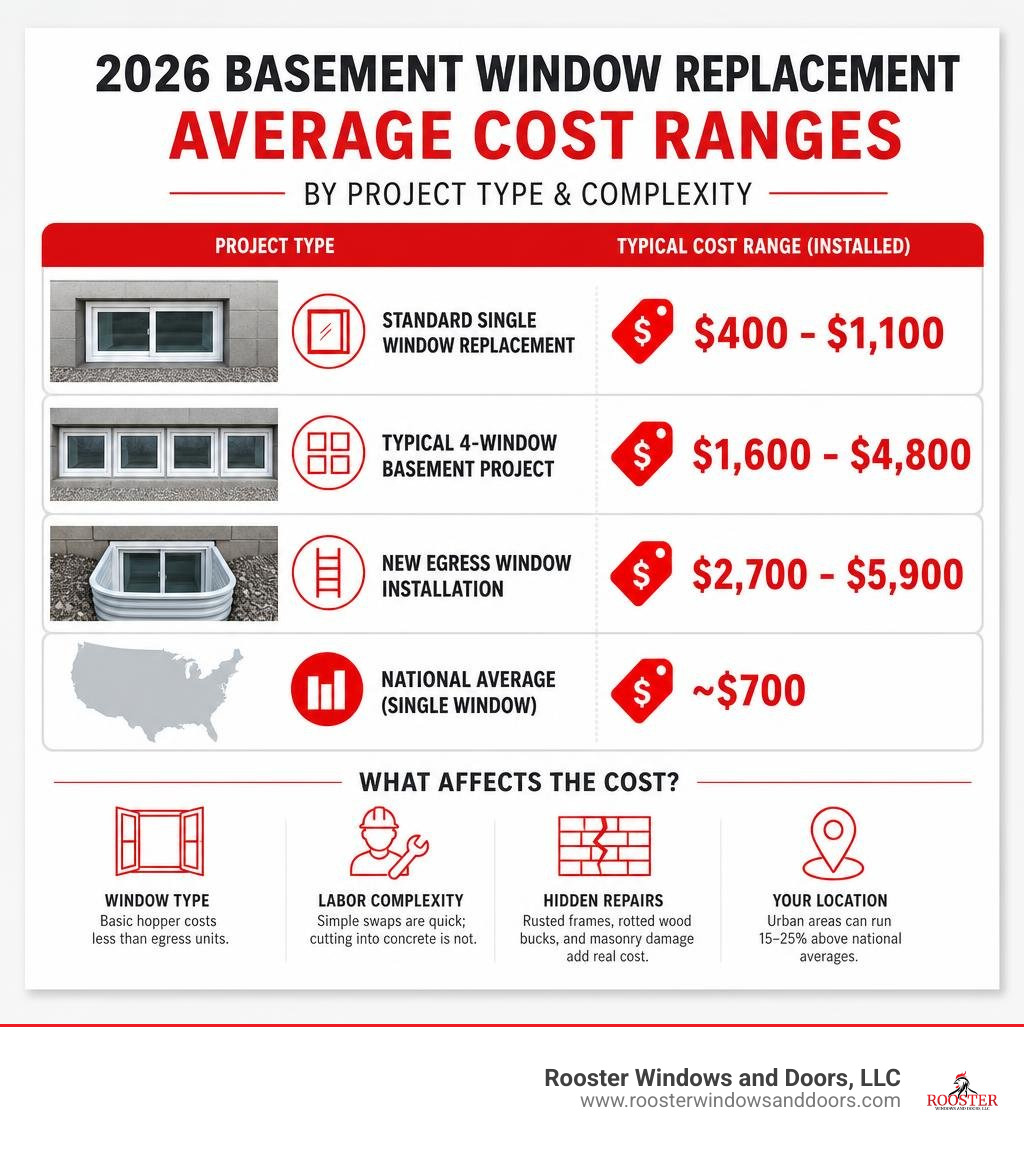
The cost of basement window replacement in 2026 typically falls between $400 and $1,200 per window installed, depending on window type, frame material, and how much structural work is involved.
Here’s a fast snapshot to help you budget:
| Project Type | Typical Cost Range |
|---|---|
| Standard single window replacement | $400 – $1,100 |
| Typical 4-window basement project | $1,600 – $4,800 |
| New egress window installation | $2,700 – $5,900 |
| National average (single window) | ~$700 |
A few things drive that wide range:
- Window type — a basic hopper costs far less than a code-compliant egress unit
- Labor complexity — swapping an existing window is quick; cutting into concrete is not
- Hidden repairs — rusted steel frames, rotted wood bucks, and masonry damage add real cost
- Your location — urban Chicagoland labor rates can run 15–25% above national averages
If your basement windows are leaking, drafty, or just outdated, you’re probably already losing money on energy bills and risking water damage. This guide breaks down every cost you should expect — so you can compare quotes with confidence and avoid surprises.
I’m Piotr Wilk, and over more than two decades of installing windows in the Chicagoland area, I’ve helped hundreds of homeowners navigate the real cost of basement window replacement — from simple hopper swaps to full egress conversions in Lake, Cook, and McHenry County. Keep reading for a complete breakdown of what you should expect to pay, and why.
Average Cost of Basement Window Replacement in 2026
When homeowners across Chicagoland ask us what they should set aside for their lower-level project, we usually start with the baseline averages. Nationally, replacing a standard basement window averages around $700, with most straightforward replacements landing between $400 and $1,000 per unit installed.
However, project scale changes the total math. If you are replacing all four standard hopper or slider windows in a typical suburban basement, you can expect a project total between $1,600 and $4,800. The cost split generally sits at roughly 50% for the physical window unit and materials, and 50% for skilled installation labor. Labor alone averages $100 to $300 per window for a straightforward retrofit, though it can climb up to $600 or more if custom sizing or frame repairs are needed.
According to recent 2026 window replacement pricing data, overall window unit costs across all styles range between $450 and $1,200 per opening installed, with overall house projects scaling based on bulk order efficiencies. In lower-level installations, cost differences emerge when comparing a direct frame insert against creating a brand-new egress opening.
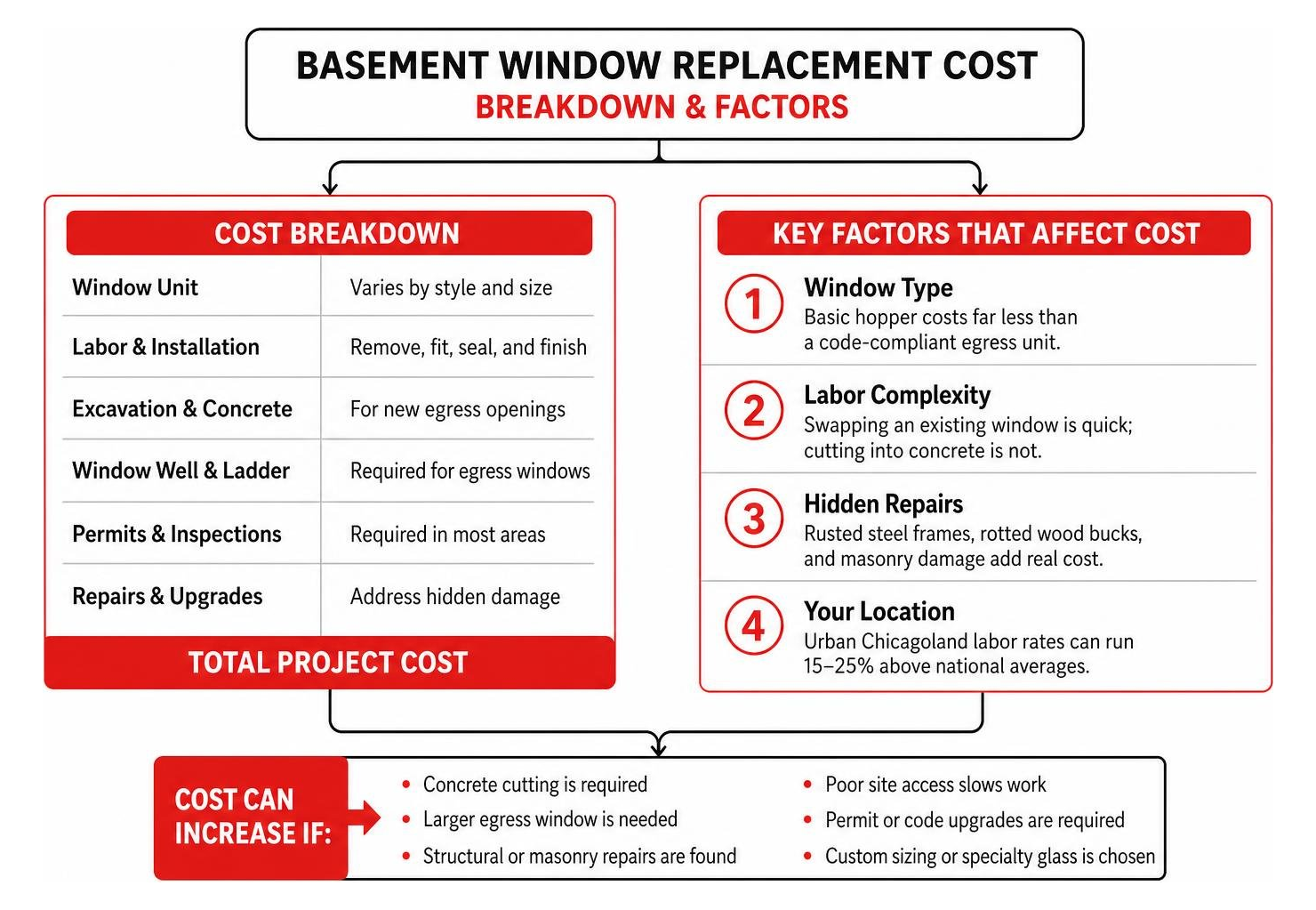
| Cost Component | Standard Retrofit Replacement | New Egress Window Installation |
|---|---|---|
| Window Unit Cost | $100 – $800 | $800 – $2,000 |
| Basic Labor & Sealing | $100 – $300 | $700 – $2,500 |
| Excavation & Gravel | N/A | $800 – $2,000 |
| Concrete Saw Cutting | N/A | $500 – $1,500 |
| Window Well & Ladder | N/A | $500 – $1,550 |
| Permits & Inspections | $50 – $150 | $150 – $600 |
| Total Expected Cost | $400 – $1,100 | $2,700 – $5,900 |
Breakdown of the Cost of Basement Window Replacement by Style
The overall cost of basement window replacement hinges heavily on the specific style of window you install. Lower levels require styles that accommodate ground clearances, moisture resilience, and compact rough openings. Explore our complete guide to basement windows to learn more about selecting the right style for your living space.
- Hopper Windows ($400 – $800 installed): Hinging at the bottom and opening inward from the top, hopper windows are the most common standard choice. Prefabricated hopper units cost $100 to $300 for the unit alone. Because they open inward, they do not require deep exterior clearance.
- Basement Sliders ($500 – $1,000 installed): Gliding horizontally on a track, sliders offer excellent ventilation and ease of operation. Unit prices run from $150 to $500. They are perfect for wide, short rough openings in poured concrete foundations.
- Glass Block Windows ($200 – $600 installed): Popular for security and thermal mass, glass block windows can be ordered solid or equipped with a built-in air vent. They resist moisture damage completely, though they offer limited air circulation compared to operable sashes.
- Casement Windows ($600 – $1,200 installed): Hinged on the side and opening outward via a hand crank, casements provide top-tier energy efficiency because wind presses the sash tighter against the weather stripping.
- Egress Windows ($2,500 – $5,000+ installed): Specifically designed to meet safety codes for emergency escape, egress units are larger casement or sliding windows paired with proper wells and ladders.
For an extensive review of opening styles, check out our replacement basement window complete guide and our general basement window replacement guide 2026.
Frame Materials and Energy Package Upgrades
Frame material and glass choices directly influence both your initial quote and your long-term heating bills.
- Vinyl Frames ($100 – $650 unit cost): Vinyl is the gold standard for subterranean applications. It will not rot when exposed to damp soil, never needs painting, and delivers outstanding thermal insulation at an affordable price point.
- Fiberglass Frames ($300 – $900 unit cost): Extremely strong and dimensionally stable, fiberglass expands and contracts at the exact same rate as glass, reducing seal failures over time. While costing 20% to 40% more than vinyl, it handles damp soil conditions exceptionally well.
- Wood Bucks and Frames ($250 – $1,000 unit cost): Modern installations rarely use exposed exterior wood frames near grade level due to rot and termite risks. However, underlying wood bucks (the framing timber set inside the masonry opening) must often be replaced during a full-frame upgrade.
Upgrading your glass package also impacts the project cost:
- Double-Pane Glass: Baseline standard, offering adequate insulation.
- Low-E Coatings with Argon Gas: Adds roughly 30% to glass costs but reflects radiant heat back into your home during winter, significantly cutting draftiness.
- Triple-Pane Glass: Adds roughly 80% to glass costs. Highly effective in cold Midwestern climates for maximum energy payback and sound dampening.
To calculate how framing and glass packages scale across standard residential units, refer to our cost to replace a window ultimate guide.
Key Cost Factors and Hidden Expenses
Why do quotes for seemingly identical window swaps differ between houses? Beyond basic window dimensions, site conditions heavily influence contractor labor estimates.
Contractors factor in site access, foundation material, minimum labor blocks, and overhead. For basic installations, contractors typically apply a 13% to 22% markup to cover trade supervision, licensing, and insurance. Minimum labor charges often apply, running 2 to 4 hours minimum even for small single-unit swaps. To explore localized component breakdowns, review the basement window cost calculator guide.
Permit fees also play a role. A standard retrofit window swap may carry a modest local building permit fee ($50 to $150), whereas cutting a foundation wall for an egress installation mandates full plan reviews and structural inspections ($150 to $600).
Masonry, Water Protection, and Structural Alterations
Older Midwestern basements often harbor structural conditions that require correction before a new window can be flashed and sealed:
- Rusted Steel Frame Removal ($150 – $600+ per window): Many homes built between 1950 and 1980 featured steel hopper frames embedded directly into freshly poured concrete or cinder blocks. Cutting out rusted steel without fracturing the surrounding foundation requires specialized power tools and extra labor time.
- Rotted Wood Buck Replacement ($150 – $700 per opening): If water has leaked past old caulking for years, the structural wood buck behind the frame is frequently rotted. We must remove the decayed wood, treat the concrete, and build a fresh pressure-treated buck.
- Masonry Patching ($200 – $900 per opening): Chipped, spalling, or cracked concrete around the rough opening requires hydraulic cement patching to ensure a smooth, watertight seal.
- Drainage Correction ($250 – $1,500): If exterior soil slopes toward your basement windows, water will accumulate against the new glass. Regrading or adding foundation drainage tiles ensures your investment stays dry.
For more details on comprehensive lower-level project expenses, consult our window replacement cost ultimate guide.
Evaluating DIY vs Professional Cost of Basement Window Replacement
It can be tempting to browse home improvement store shelves and consider installing a prefabricated $150 vinyl window yourself. While a handy homeowner might save $200 to $400 in direct labor fees per window, lower-level projects carry distinct structural and moisture risks.
- Water Infiltration: Subterranean openings are exposed to heavy groundwater runoff. Imprecisely expanding foam, improper flashing tape, or missing exterior masonry caulk can lead to quiet water leaks behind drywall, triggering costly mold remediation.
- Structural Safety: Installing windows into concrete masonry unit (CMU) blocks or poured concrete foundation walls requires verifying load distribution. Removing structural support without placing a steel or reinforced header can cause upper-level floor sagging.
- Specialized Tools: Cutting concrete or removing steel frames requires diamond-blade masonry saws, heavy hammer drills, and personal protection equipment. Tool rentals alone can quickly cost $150 to $300 per day.
Working with experienced basement window replacement contractors ensures your installation remains completely watertight and strictly compliant with local building codes. If you want to review the full step-by-step technical process, see our guide on how to install new basement window.
Standard Replacement vs. Egress Window Installation
The single largest cost jump in lower-level window work occurs when transitioning from a standard light-and-ventilation window to a legal egress window.
Under International Residential Code (IRC) regulations, any finished basement living space or bedroom must have at least one emergency egress window. IRC code dictates:
- Minimum Clear Opening: 5.7 square feet (5.0 sq ft if at grade level)
- Minimum Opening Height: 24 inches tall
- Minimum Opening Width: 20 inches wide
- Maximum Sill Height: No more than 44 inches off the finished floor
Because standard basement windows are typically 14 to 24 inches high and set high on the foundation wall, converting to egress almost always requires excavating outside soil, saw-cutting down into the concrete foundation, and installing a deep subterranean window well. For a comprehensive look at national code compliance pricing, check out this egress window pricing guide.
Window Wells, Ladders, and Subterranean Drainage
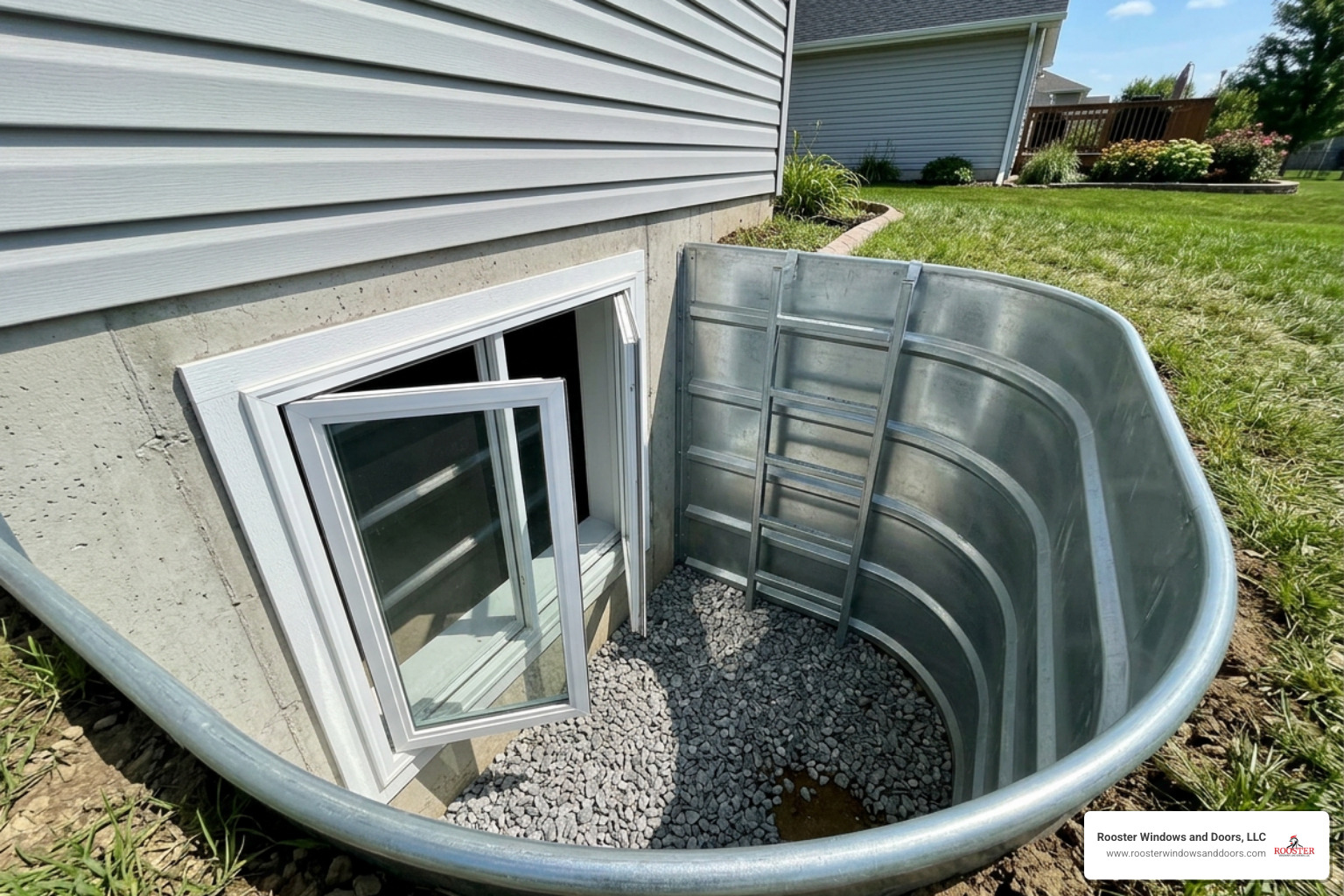
When an egress window sill sits below exterior grade, a code-compliant window well must be attached to the foundation wall.
- Window Wells ($400 – $1,200 material cost): Wells must extend at least 36 inches outward from the foundation wall and provide a minimum floor area of 9 square feet. Options range from basic corrugated galvanized steel to decorative composite stone wells.
- Escape Ladders ($100 – $350): If the window well depth exceeds 44 inches from top to bottom, building code mandates a permanently affixed ladder or stair step system.
- Gravel Footings & Drainage ($300 – $800): A 6- to 12-inch deep bed of washed pea gravel must fill the bottom of the well. This layer connects directly to your home’s exterior footing drain tile or a dedicated dry well to keep rainwater from backing up into the window frame.
- Well Covers ($150 – $450): Clear, UV-resistant poly carbonate covers keep leaves, snow, and animals out of the well while supporting emergency exit weights (typically up to 500 lbs).
Return on Investment and Resale Home Value
While a complete egress installation costs $2,700 to $5,900, it delivers one of the highest returns on investment in home remodeling.
- Addition of Legal Bedrooms: Adding an egress window allows an existing basement room to be legally counted as a bedroom on official real estate listings. Adding a official bedroom typically increases home appraisal value by $15,000 to $30,000, delivering a 3x to 5x return on project cost.
- Standard Window Resale Recovery: Standard window swaps recover roughly 45% to 60% (52.5% national average) of their cost at home resale, while immediately stopping thermal loss.
- Federal Tax Credits: Under the Energy Efficient Home Improvement Credit, qualifying Low-E energy-efficient replacement windows can qualify for federal tax credits covering up to 30% of unit costs (capped at $600 annually).
Read our full analysis on home value improvements in our real cost of new windows guide.
Frequently Asked Questions About Basement Window Costs
What is the average cost to replace a single basement window?
The average cost to replace a single standard basement window in 2026 is $700, with a typical complete range of $400 to $1,100. This includes a quality vinyl hopper or slider window unit ($150 to $500) combined with professional removal, installation, perimeter foam insulation, exterior caulking, and cleanup labor ($100 to $300).
How much extra does it cost to cut a new window opening into concrete?
Cutting a brand-new or expanded window opening through a concrete foundation wall typically adds $1,500 to $3,500 to the baseline project cost. Concrete saw cutting labor runs $500 to $2,000 depending on wall thickness and steel rebar, while installing a structural steel header (lintel) adds another $300 to $800. Exterior excavation adds $800 to $2,000.
Does adding an egress window increase home appraisal value?
Yes! Installing a code-compliant egress window turns an unofficial basement area into a legal bedroom. Real estate appraisers value legal basement bedrooms at $15,000 to $30,000 in added market value, far exceeding the average installation cost of $3,850 to $4,200.
Conclusion
Understanding the real cost of basement window replacement comes down to knowing your home’s structural requirements, choosing moisture-resistant frame materials, and deciding whether standard ventilation or a full legal egress transformation best fits your goals.
At Rooster Windows and Doors, we bring over two decades of local expertise to every installation across Chicagoland. From simple vinyl hopper upgrades in Libertyville, Lake Forest, and Highland Park to structural egress conversions in Vernon Hills, Arlington Heights, and Chicago, our team delivers high-quality, flawless, and energy-efficient installations tailored to your home’s unique needs.
Ready to brighten your space, lower energy bills, and protect your foundation? Explore our professional basement window installation services or contact our team today to schedule an expert on-site evaluation for your home. You can also visit our localized basement window installation Chicago page to see examples of our recent work near you.


