

The Pane Truth About Casement Window Glass Replacement
What You Need to Know About Casement Glass Replacement
Casement glass replacement is one of the most common window repairs homeowners face — and the good news is that in many cases, you don’t need to replace the entire window to fix it.
Here’s a quick answer based on your situation:
| Problem | Best Solution |
|---|---|
| Fogging or condensation between panes | Replace the insulated glass unit (IGU) |
| Single cracked or broken pane | Glass-only replacement |
| Failed seal with intact frame and sash | Glass-only replacement |
| Damaged frame, sash, or hardware | Full window replacement |
| Drafts that persist after glass replacement | Full window replacement |
Replacing just the glass is typically far more affordable than a full window swap — and when your frame and sash are still in good shape, it’s often the smarter move. That said, casement windows have some quirks that make glass replacement a little more involved than a standard picture window. They’re operable — meaning they crank open on hinges — so the sash, hardware, and glazing all have to work together precisely after the repair.
This guide walks you through everything: how to spot the problem, choose the right glass, and replace it safely — whether you’re going DIY or deciding when to call in a pro.
I’m Piotr Wilk, and through Rooster Windows and Doors, LLC, I’ve spent over two decades installing and repairing windows across the Chicagoland area, including countless casement glass replacement jobs in Lake, Cook, and McHenry County. Let’s get into exactly what you need to know.
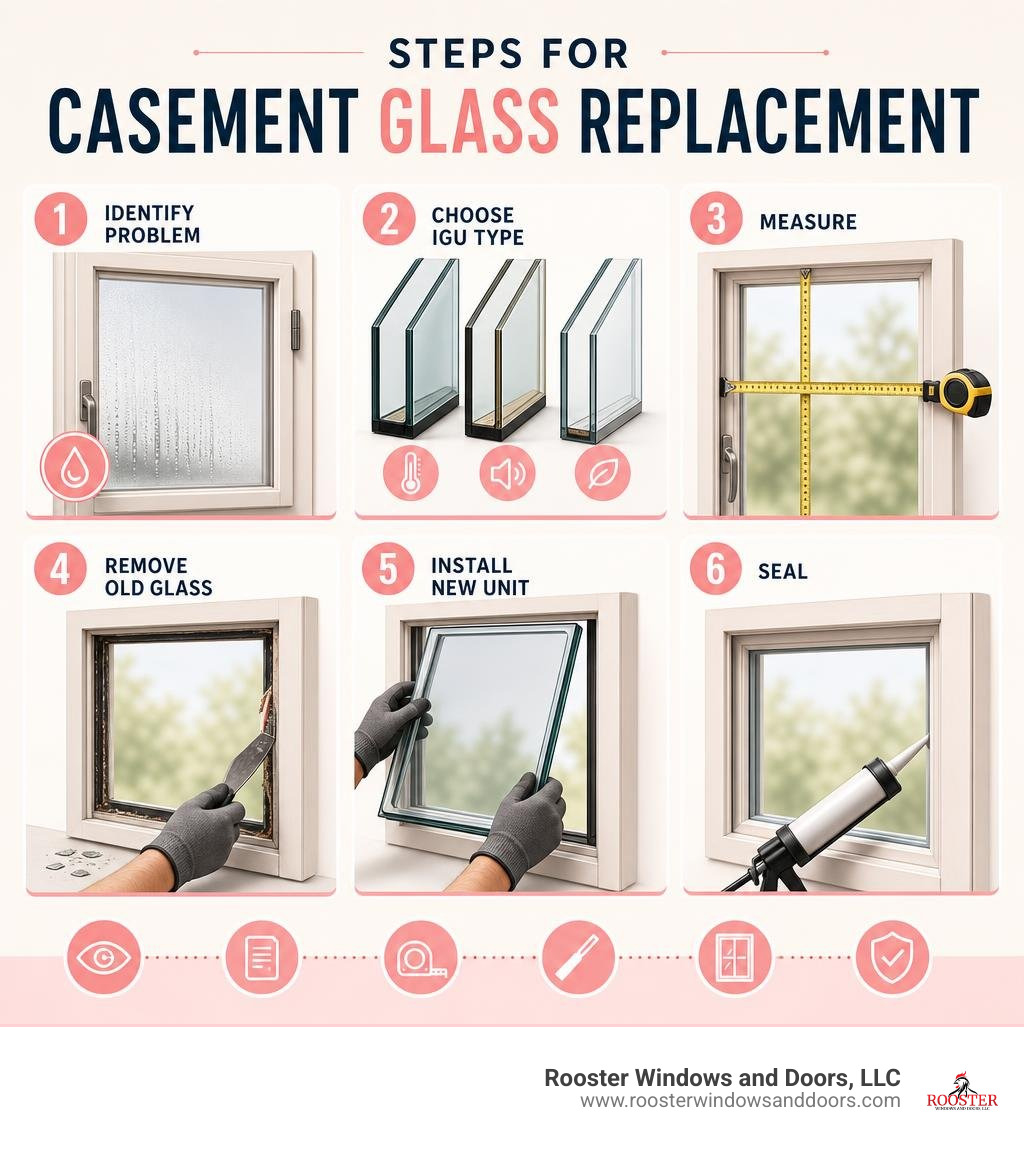
Essential casement glass replacement terms:
Signs Your Casement Window Needs New Glass

Before you break out the toolbox or call us to schedule an installation, you need to know if your glass is actually the culprit. Casement windows (often called crank-out windows) are fantastic for catching breezes, but because they move, they are subject to unique wear and tear.
Here are the primary indicators that your casement window is crying out for new glass:
1. Fogging and Condensation Between the Panes
If your window looks like a steam room but you can’t wipe the moisture off from either the inside or the outside, you have a blown seal. Modern casement windows use double-pane or triple-pane insulated glass units (IGUs). The space between these panes is sealed at the factory and often filled with insulating gas. When that seal fails, moist air sneaks in, condenses, and creates a permanent foggy look.
For a deeper dive into how this happens and what it means for your home, check out our guide on Chicago’s Clear Choice: Navigating Double Pane Window Glass Replacement.
2. Drafts and Cold Spots
If sitting next to your closed casement window in the dead of a Chicagoland winter feels like sitting next to an open freezer, your glass unit has likely lost its insulating capabilities. Over time, the argon or krypton gas that keeps the heat inside can leak out through microscopic seal failures, rendering the unit highly inefficient.
3. Physical Cracks, Chips, or “Star” Breaks
This is the most obvious sign. Whether it was a stray baseball, a violent hailstorm off Lake Michigan, or an unfortunate encounter with a kicked-up pebble while mowing the lawn, a cracked pane is a safety hazard and an energy drain. Cracks will expand over time due to temperature fluctuations, eventually causing the entire unit to fail or shatter.
If you live in our service areas and notice these issues, you aren’t alone. Homeowners frequently require localized solutions. Whether you need home window repair in Libertyville IL, are looking into Grayslake window glass repair, or need a reliable window glass replacement service in Buffalo Grove IL, identifying these warning signs early can save you from costlier structural damage down the line.
Glass-Only Unit vs. Full Window Replacement

When a casement window fails, homeowners often wonder: Do I have to buy a whole new window, or can I just swap out the glass?
We always prefer to save our customers money when possible. If your window frame is structurally sound, replacing just the glass unit is significantly more affordable than a full window replacement, often saving homeowners hundreds of dollars per window.
Let’s break down the differences to help you decide:
| Feature | Glass-Only Replacement | Full Window Replacement |
|---|---|---|
| Average Cost | Lower (typically $300 – $600 per unit) | Higher (typically $600 – $1,200+ per window) |
| Installation Time | 1 to 2 hours | 4 to 8 hours (requires exterior trim work) |
| Frame Disruption | None; original frame and trim remain intact | High; interior and exterior trim often removed |
| When to Choose | Frame and sash are in great condition; only glass is broken/foggy | Frame is rotted, warped, out of square, or hardware is broken |
Assessing Frame and Sash Integrity
Before ordering glass, we must inspect the wood or vinyl sash holding the glass.
- For Vinyl and Metal Casements: These are highly resilient, but check for warping. If the vinyl sash has warped, a new glass unit might not fit or seal properly.
- For Wood Casements: Wood is beautiful but susceptible to moisture. If you live in areas with high humidity variations, you might find structural issues. For example, if you need rotten wood window repair in Vernon Hills, IL, we must repair or replace the wood sash before putting new glass in. Trying to install fresh glass into a rotting wood sash is like putting a band-aid on a leaky pipe.
To understand the full financial scope of window projects, review our Window Replacement Cost Ultimate Guide. If you choose to upgrade the entire system for maximum performance, you can read more about Energy Efficient Window Installation.
Step-by-Step Guide to Casement Glass Replacement
Replacing the glass in an operable casement window sash requires patience and precision. Because casement sashes swing open, they rely on the glass itself to keep the sash perfectly square. If you install the glass slightly crooked, the window won’t close or lock properly.
For those working with premium brands, we highly recommend reviewing the official manufacturer documentation, such as the Andersen Service Guide, which covers glass replacement for 400 Series and other casement picture/transom units.
Below, we’ve broken down the DIY process for standard operable casement windows.
Tools and Materials for Casement Glass Replacement
Before starting, gather the following tools and safety gear:
- Safety glasses and heavy-duty cut-resistant gloves (non-negotiable!)
- Duct tape (to secure cracked glass)
- Nylon putty knife and a stiff metal putty knife
- Flat pry bar
- High-quality neutral-cure silicone sealant (such as Dow Corning 1350 or 791)
- Rubber setting blocks (essential for keeping the glass centered and square)
- Glass suction cups (highly recommended for handling larger IGUs safely)
- Glass cleaner and microfiber cloths
How to Safely Perform Casement Glass Replacement
Step 1: Secure the Broken Glass and Prep the Area
If the glass is cracked, cover the cracks completely with duct tape on both sides. This keeps the glass from shattering into tiny shards while you work. Clear the area around the window, and keep children and pets away.
Step 2: Remove the Window Sash (Optional but Recommended)
While some windows can be reglazed in place, removing the operable sash makes the job much safer and easier.
- Crank the window open slightly.
- Locate the hinge arms at the top and bottom of the sash.
- Depending on your brand, you will either need to back out the screws securing the hinge arms or pop off the quick-release connecting arms.
- Carefully lift the sash off its track and lay it flat on a padded worktable (an old blanket on a folding table works perfectly).
Step 3: Remove the Glazing Stops
Glazing stops are the thin vinyl, wood, or aluminum strips around the perimeter of the glass on the interior side.
- Slide your thin putty knife into the seam between the stop and the sash frame.
- Gently pry upward. Work your way slowly down the length of the stop to avoid snapping it.
- Remove all four stops and label them (Top, Bottom, Left, Right) so they go back into their exact original positions.
Step 4: Cut the Silicone Bed Glazing
The glass unit is held to the sash frame by a bead of structural silicone (the glazing bed).
- From the exterior side of the sash, carefully slide a utility knife or a thin putty knife between the glass and the frame.
- Cut through the silicone sealant around the entire perimeter of the glass. Take your time; rushing here can gouge wood sashes or slice your hands.
Step 5: Remove the Old Glass Unit
- Using glass suction cups (or pushing gently from the outside), lift the old IGU out of the sash frame.
- Safely set the old glass aside for disposal.
Step 6: Clean the Sash Frame
- Use your putty knife to scrape away all remaining old silicone and adhesive from the sash frame.
- Wipe the frame down with mineral spirits to remove grease and residue. Let it dry completely.
Step 7: Place Setting Blocks and Test Fit
- Place rubber setting blocks in the bottom corners of the frame. These blocks prevent the glass from resting directly on the frame and help distribute the weight so the sash stays square.
- Set the new glass unit into the frame to test the fit. Ensure there is an even gap (about 1/16 to 1/8 inch) around the entire perimeter.
Step 8: Apply Silicone and Install the New IGU
- Lift the glass back out.
- Apply a continuous 1/4-inch bead of high-quality silicone sealant along the glazing bed of the frame.
- Carefully set the new glass unit back onto the setting blocks and press it firmly into the silicone bead.
- Important: Ensure the manufacturer’s logo (if visible) is readable from the interior of the room. This ensures any specialized Low-E coatings are facing the correct direction!
Step 9: Reinstall Glazing Stops and Apply Fillet Bead
- Snap or nail the glazing stops back into place. If you have a wood sash, use small finish nails driven at a shallow angle (no more than 10 degrees) to avoid hitting and cracking the new glass.
- On the exterior side, apply a neat 3/16-inch fillet bead of silicone where the glass meets the sash frame to ensure a completely watertight seal.
- Smooth the bead with a soapy finger or a caulking tool.
Step 10: Reinstall the Sash and Let It Cure
- Reattach the sash to the window frame hinges and hardware.
- Close and lock the window to hold everything tightly in place while the silicone cures.
- Let the silicone cure fully (usually 24 to 48 hours) before opening or operating the window.
Frequently Asked Questions About Casement Windows
Can you replace casement window glass without replacing the frame?
Yes, absolutely! If your window frame is structurally sound, free of rot, and square, there is no reason to rip it out. Replacing only the glass unit within the existing sash preserves your interior trim, exterior siding, and saves you a significant amount of money.
To understand how casement windows compare to other styles in terms of parts and frames, you can read about the different Types of Casement Windows or check out our comprehensive Window Glass Replacement in Chicago guide.
How do you measure and order replacement insulated glass units?
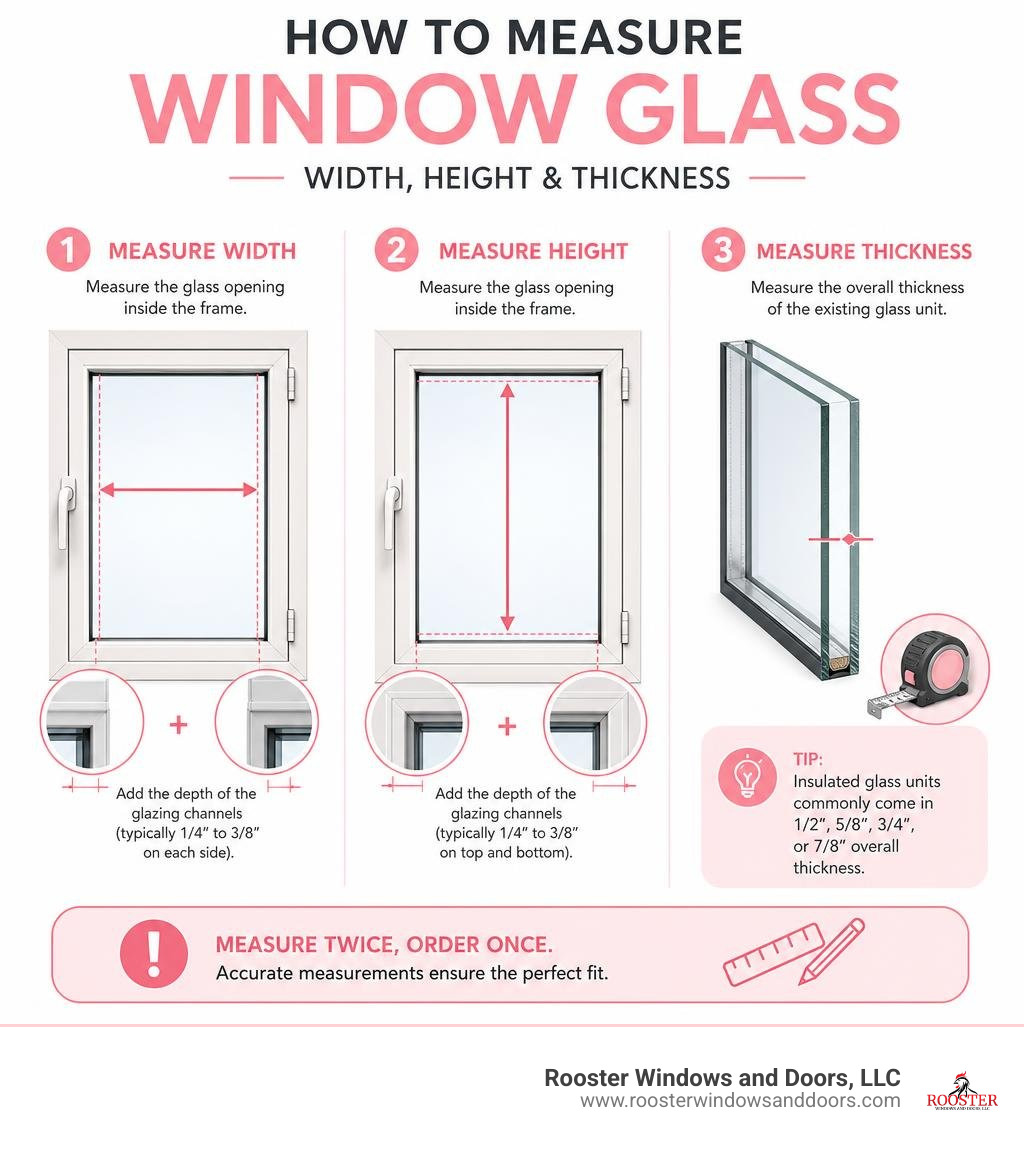
Getting the measurements right is the most critical step of a DIY glass replacement. If your new glass is even 1/16 of an inch too thick or too wide, it will not fit back into the sash.
Here is how to measure like a pro:
- Measure the Width and Height: Measure the visible glass opening from inside the frame, then add the depth of the glazing channels (typically 1/4 to 3/8 inch on each side) to get the actual glass size. Alternatively, measure the exact edge-to-edge width of the existing glass unit if you have already removed it.
- Measure the Thickness: Insulated glass units come in various overall thicknesses (typically 1/2 inch, 5/8 inch, 3/4 inch, or 7/8 inch). Measure the thickness of your old unit precisely.
- Specify the Glass Type:
- Double-Pane vs. Triple-Pane: Match your home’s existing configuration.
- Low-E Coating: Highly recommended for blocking UV rays and keeping your home comfortable.
- Argon Gas: An insulating gas filled between panes to boost energy efficiency.
- Tempered Glass: Required by building codes if the window is close to the floor, near a door, or in a bathroom.
Sourcing Branded Glass
If you have a popular brand like Andersen, sourcing replacement parts is highly standardized. For instance, the Andersen 100 Series Casement replacement glass is a special order part (Part #: 100csmtglass). It cannot be purchased online, but you can order it directly by calling 1-877-835-9090.
When should you call a professional for glass replacement?
While a simple glass swap on a small, accessible window can be a rewarding DIY project, there are times when it is best to step aside and let the professionals handle it.
You should call us if:
- The Window is on a Second Story or Higher: Working on ladders with heavy, sharp sheets of glass is incredibly dangerous.
- The Sash is Severely Rotted or Damaged: If the frame itself is falling apart, simply putting new glass in won’t solve your draft or moisture problems.
- The Window Has Complex Hardware: High-end casement windows often feature multi-point locking systems and complex hinge tracks that require expert calibration.
- You Want to Protect Your Warranty: Professional installation ensures your manufacturer warranties remain fully intact.
For local homeowners seeking expert assistance, we provide professional services across our service areas. If you need window installation and replacement in Mundelein IL or require experienced technicians for window installation and replacement in Lake Zurich IL, our team is ready to step in.
Conclusion
Dealing with a broken, drafty, or foggy casement window can be a headache, but now you know the “pane” truth: you don’t always have to replace the entire window assembly. Replacing just the insulated glass unit is a highly cost-effective, efficient, and environmentally friendly way to restore your home’s energy efficiency and clear views.
Whether you choose to tackle this project yourself using our step-by-step guide or decide that handling large sheets of glass on a ladder isn’t your idea of a fun weekend, we are here to help. At Rooster Windows and Doors, LLC, we specialize in providing flawless, high-quality, and energy-efficient window installations and glass replacements tailored specifically to your home’s needs.
We serve homeowners throughout the Chicagoland area—including Libertyville, Lake Forest, Highland Park, Vernon Hills, Grayslake, Mundelein, Lake Zurich, Buffalo Grove, and many more local communities.
Ready to restore your home’s comfort and clarity? Visit our Replacement Casement Windows page to schedule a professional consultation with our team today!
