

Choosing the Right Accuride Pocket Door Series for Your Project
Selecting the right accuride pocket door system requires balancing maximum door weight, height, width, and cabinet depth. Utilizing the wrong slide mechanism can lead to door sag, binding, racking, or premature failure of the ball bearings. When specifying cabinet hardware for high-end residential or commercial projects, choosing the proper load rating and track geometry ensures smooth, long-term operation without frustrating mechanical failures.
When specifying specialty cabinet hardware, compare system limits directly to your architectural plans or door construction specs:
| Model Series | Max Door Weight | Max Door Height | Max Door Width | Door Thickness Range | Included Hinges? |
|---|---|---|---|---|---|
| Accuride 123 | 30 lbs (13.6 kg) | 42 in (1,067 mm) | 24 in (610 mm) | 5/8″ to 1-1/4″ | Yes (35 mm clip-on) |
| Accuride 1234 | 30 lbs (13.6 kg) | 42 in (1,067 mm) | 42 in (1,067 mm) | 5/8″ to 1-1/4″ | No (ordered separately) |
| Accuride 1321 | 30 lbs (13.6 kg) | 42 in (1,067 mm) | 24 in (610 mm) | 3/4″ to 1-1/4″ | Yes (with Auto-Open) |
| Accuride 1332 | 75 lbs (34.0 kg) | 78 in (1,981 mm) | 26 in (660 mm) | 3/4″ to 1-1/4″ | Optional kits (35/40 mm) |
| Accuride 1432 | 75 lbs (34.0 kg) | 78 in (1,981 mm) | 26 in (660 mm) | 3/4″ to 1-1/4″ | No (separate carrier kit) |
| Accuride 1532 | 100 lbs (45.4 kg) | 118 in (3,000 mm) | 39 in (990 mm) | Up to 1-1/4″ | Integrated cassette kit |
For light applications, review the official specifications for the to see standard sizing options.
Light-Duty Options: Accuride 123 and 1234 Accuride Pocket Door Systems
Light-duty systems are ideal for vanity cabinets, small entertainment centers, or residential wet bars. Both the 123 and 1234 models feature a 30 lb (13.6 kg) load capacity and utilize steel ball bearings, hold-out detents, and a self-aligning design that simplifies spatial setup and routine door usage.
- Accuride 123: Package includes 35 mm self-closing clip-on hinges, two slides, pivot blocks, and mounting hardware. Designed for vertical doors up to 42″ H x 24″ W.
- Accuride 1234: Distributed without hinges, allowing custom hinge pairings for special overlays. Supports larger door widths up to 42″ W x 42″ H depending on vertical or horizontal mounting.
When fitting smaller cabinetry, integrating a lightweight pocket door mechanism creates a clean, uncluttered profile without sacrificing floor space.
Medium and Heavy-Duty Models: Accuride 1321, 1332, and 1432 Accuride Pocket Door Slides
Medium and heavy-duty series accommodate full-length armoires, kitchen pantries, and entertainment centers requiring larger panels that handle heavier usage.
- Accuride 1321: Features an integrated Auto-Open mechanism. Near the end of travel, internal springs push the door panel forward, preventing hand scuffs and cabinet strikes.
- Accuride 1332: Supports doors up to 75 lbs (34 kg) and up to 78 inches tall by 26 inches wide. Utilizes an Anti-Rak cable system that synchronizes runner movement to eliminate door twist. See detailed specifications on the.
- Accuride 1432: Built for heavy-use 75 lb applications. It relies on a cable system to synchronize top and bottom slides, delivering smooth operation on panels from 36 to 78 inches tall.
Extra-Large Applications: The Accuride 1532 System
For floor-to-ceiling cabinetry, hidden room partitions, or large micro-living enclosures, the accuride pocket door 1532 system is built for heavy panels requiring robust support mechanisms.
- Load Capacity: 100 lbs (45.4 kg) max door weight.
- Panel Limits: Up to 118 inches tall, 39 inches wide, and 1.25 inches thick.
- Cassette Engineering: Uses an aluminum top track with an internal cassette and anti-racking cable mechanism.
To review full engineering diagrams for tall panel installations, consult the guide for the.
Vertical Pocket Doors vs. Horizontal Flipper Doors
Cabinet design determines whether panels store vertically along side walls or horizontally above an upper shelf.
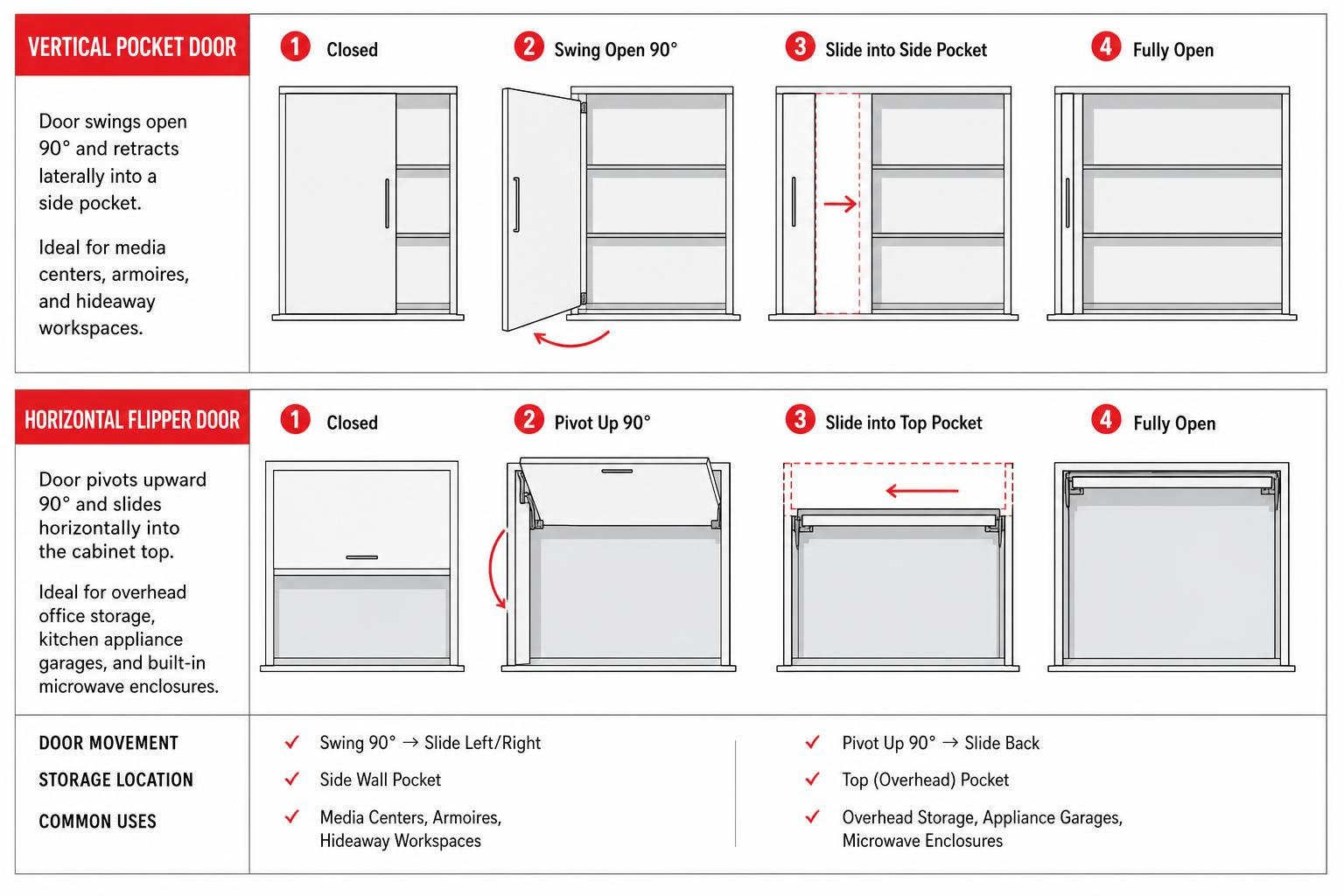
- Vertical Pocket Doors: Swing open 90 degrees and retract laterally into a side pocket. Ideal for media centers, armoires, kitchen pantries, and hideaway workspaces where side clearances permit recessed storing.
- Horizontal Flipper Doors: Pivot upward 90 degrees and slide back horizontally into the cabinet top. Common in overhead office storage, kitchen appliance garages, and built-in microwave enclosures where lateral space is constrained.
Calculating depth requires checking slide length against available cabinet interior depth and desired panel extension. Ensuring proper clearance prevents door bind and ensures smooth motion. To understand overall pocket door geometry before framing cabinetry, consult a comprehensive guide to pocket door basics.
Key Hardware Requirements, Finishes, and Hinge Options
Installing pocket door hardware correctly depends on getting the secondary accessories, hardware finishes, and hinge cup sizes right:
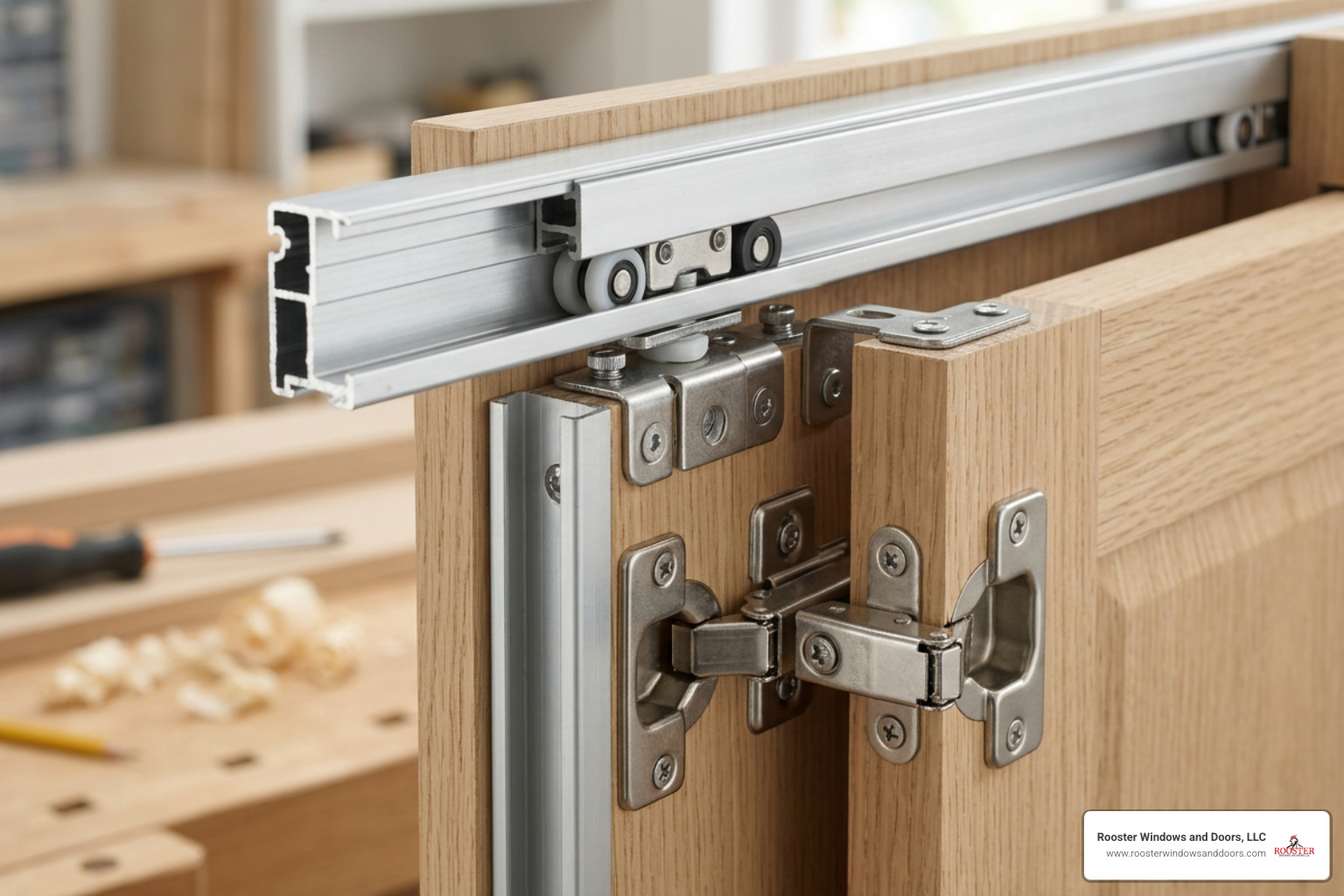
- Hinge Cup Sizes (35 mm vs 40 mm): Standard doors (5/8″ to 13/16″ thick) use 35 mm concealed hinges. Thicker doors (over 13/16″ up to 1-1/4″ thick) require 40 mm hinge cup bores to ensure pivot clearance without binding against cabinet face frames.
- Follower Strips: Models like the 123, 1234, and 1321 require a wood follower strip provided by the installer. The wood strip connects the top and bottom pivot blocks, preventing independent slide movement. It must be cut exactly 6 inches shorter than the total door height and remain 3/4″ thick or less to maintain mechanical clearance.
- Hinge Carrier Strip Kits: For heavier models like the 1332 and 1432, steel hinge carrier strips replace standard follower boards. These modular metal tracks support extra hinges required on tall doors (doors 36″ to 78″ high need 3 to 4 hinges) to distribute door mass evenly across the slide assembly.
- Finishes: Common options include Ebony Black (zinc plate with black chromate) and Clear Zinc, providing corrosion resistance and aesthetic flexibility inside dark or light wood cabinetry setups.
Step-by-Step Sizing, Installation, and Pricing Considerations
Fitting an accuride pocket door mechanism requires precise measurements and careful alignment during installation to maintain optimal function.
Installation Steps
- Determine Cabinet Pocket Depth: Select a slide runner length (available in 2-inch increments from 12″ to 32″) equal to or shorter than the internal cabinet depth.
- Prepare Wood Follower or Carrier Strip: Cut custom wood follower strips 6 inches shorter than the door panel height. Secure top and bottom pivot blocks firmly to ensure aligned rotation.
- Mount Slides to Cabinet Sides: Fix upper and lower slide tracks parallel to each other. Verify tracks are plumb, square, and level to ensure smooth, unhindered travel.
- Set Cable Tension (1332 / 1432 / 1532 Series): Route anti-rack cables around pulley blocks. Adjust cable tension at the front adjusting screw until top and bottom runners slide in exact unison without twisting or racking.
- Attach Hinges and Hang Door: Bore 35 mm or 40 mm hinge cups into door panels. Mount door onto pivot hinge plates, adjusting reveal gaps to roughly 5/16″ (8 mm) for clean door closure and smooth recessing.
Price points vary significantly based on model complexity, engineering refinements, and size ratings:
- Light-duty slide pairs (123 / 1234): $36 to $70
- Medium to heavy-duty synchronized kits (1321 / 1332 / 1432): $110 to $170
- Extra-large architectural cassette systems (1532): $800 to $815
When renovating interior cabinetry or converting traditional doorways, reviewing professional door replacement techniques helps ensure structural framing supports the total load weight effectively over time.
Frequently Asked Questions About Cabinet Pocket Door Hardware
Which Accuride pocket door models include hinges in the package?
The Accuride 123, CB123, and 1321 models ship with standard 35 mm hinges included in the primary box. The 1234, 1332, 1432, and 1532 series require ordering separate hinge kits tailored to specific door thicknesses, weight requirements, and face frame overlays.
What are the maximum door weight and dimension limits for these systems?
Light-duty models (123/1234) hold up to 30 lbs with door sizes up to 42″ H x 24″ W (or 42″ W horizontal). Heavy-duty systems (1332/1432) support 75 lbs and dimensions up to 78″ H x 26″ W. The extra-large 1532 system supports up to 100 lbs on oversized architectural panels up to 118″ tall and 39″ wide.
How do I calculate the proper slide length for my cabinet depth?
Measure the internal clear depth of your cabinet from the back wall to the inside face frame edge. Select a slide runner length that matches or is slightly smaller than this measurement. Maximum door retraction equals slide travel distance, which generally ranges from 7 to 23 inches depending on overall slide length and hardware clearance.
Professional Guidance and Architectural Door Solutions
Installing pocket door hardware on custom cabinetry requires exact tolerances, precise physical alignment, and proper structural weight management. Whether configuring compact residential storage or installing wide architectural doors across entertainment spaces, choosing solid, professionally engineered hardware keeps your living space functional, elegant, and organized.
At Rooster Windows and Doors, LLC, we bring full-service replacement and installation expertise to homeowners throughout Chicagoland—including Libertyville, Barrington, Evanston, Naperville, and Chicago. If your home project involves moving beyond cabinet doors to upgrading full-size entry, patio, or interior doors, contact us through our Door Installation Services page to schedule a professional consultation with our team.

