

Why Custom Basement Windows are the Secret to a Brighter Foundation
What Are Custom Basement Windows — and Why Do They Matter?
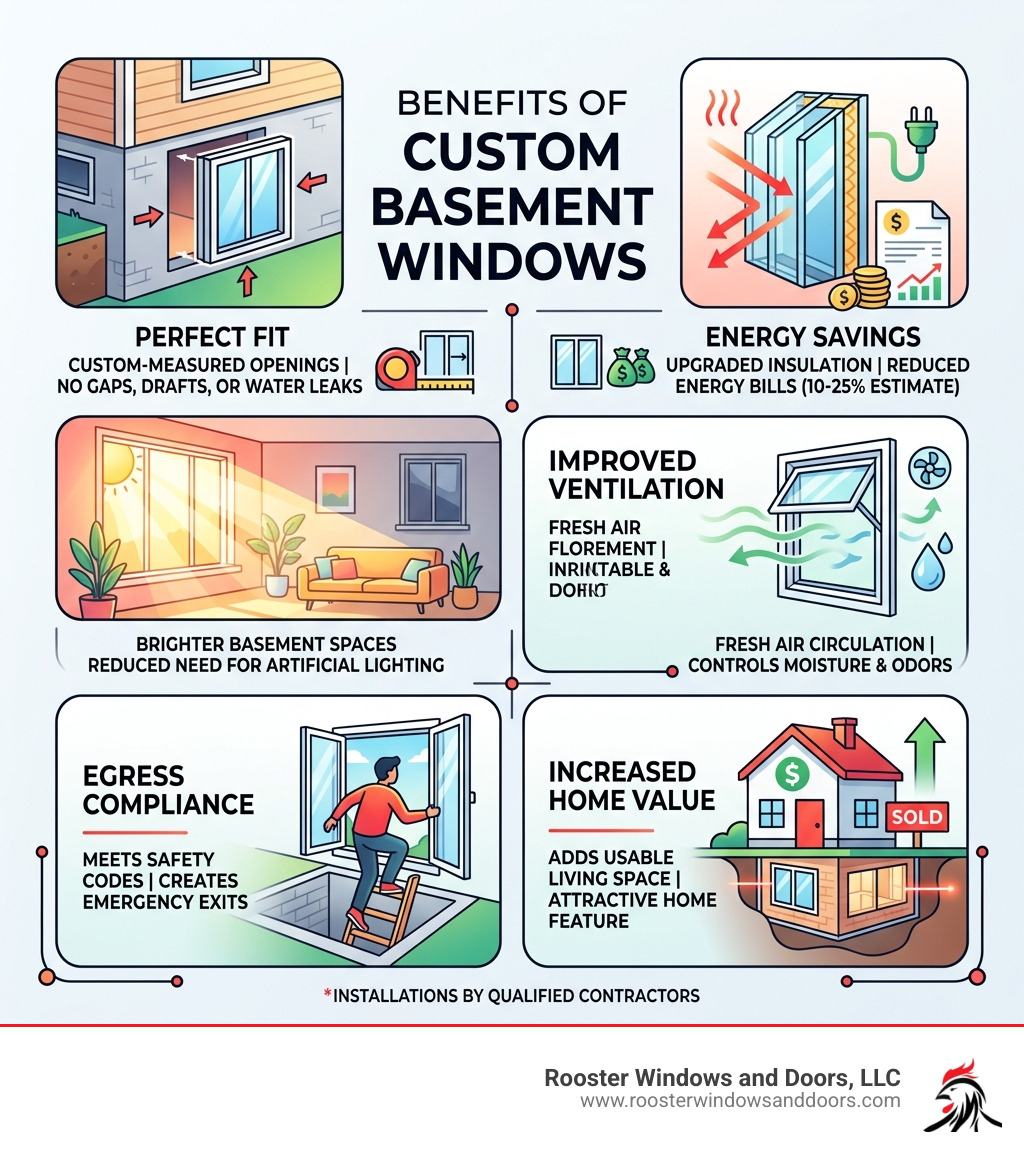
Custom basement windows are windows built to fit the exact dimensions of your basement’s wall openings, rather than forcing a standard-sized unit into a space it doesn’t quite fit.
Here’s a quick look at what they offer:
| Benefit | What It Means for You |
|---|---|
| Perfect fit | No gaps, no drafts, no water leaks |
| Better light | Natural light makes basements feel less like a cave |
| Improved ventilation | Fresh air circulation reduces moisture and odors |
| Energy savings | Upgraded windows can cut energy bills by 10–25% |
| Home value | Finished, well-lit basements add usable living space |
| Code compliance | Right-sized windows can meet egress safety requirements |
Most basements have small, awkward openings that don’t match any stock window size. That means a standard window either leaves gaps around the frame — letting in cold air, moisture, and pests — or simply won’t fit at all. Custom sizing solves that problem from the start.
Basement windows also work harder than most people realize. They’re at ground level, exposed to splashing rain, snow, and temperature swings. An old, single-pane steel window has an R-value) of about 1 — meaning almost no insulation. A quality custom window with double thermopane Low-E glass can reach an R-value close to 3, nearly tripling your insulation at one of the weakest points in your entire home’s envelope.
Whether you’re finishing a basement bedroom, improving ventilation, or simply replacing rotting frames, the right custom window makes a real difference in comfort, efficiency, and safety.
I’m Piotr Wilk, and along with the Rooster Windows and Doors team, I’ve spent over two decades installing custom basement windows across Lake, Cook, and McHenry County in the Chicagoland area. That hands-on experience — across hundreds of homes — is what shapes everything you’ll read in this guide.
Understanding the Different Types of Custom Basement Windows
When we talk about custom basement windows, it is important to realize that “one size fits all” simply doesn’t apply to the diverse architecture we see in places like Arlington Heights, Naperville, or Elgin. Depending on whether your basement is a storage area, a laundry room, or a fully finished living space, the style of window you choose will dictate how much light, air, and security you receive.
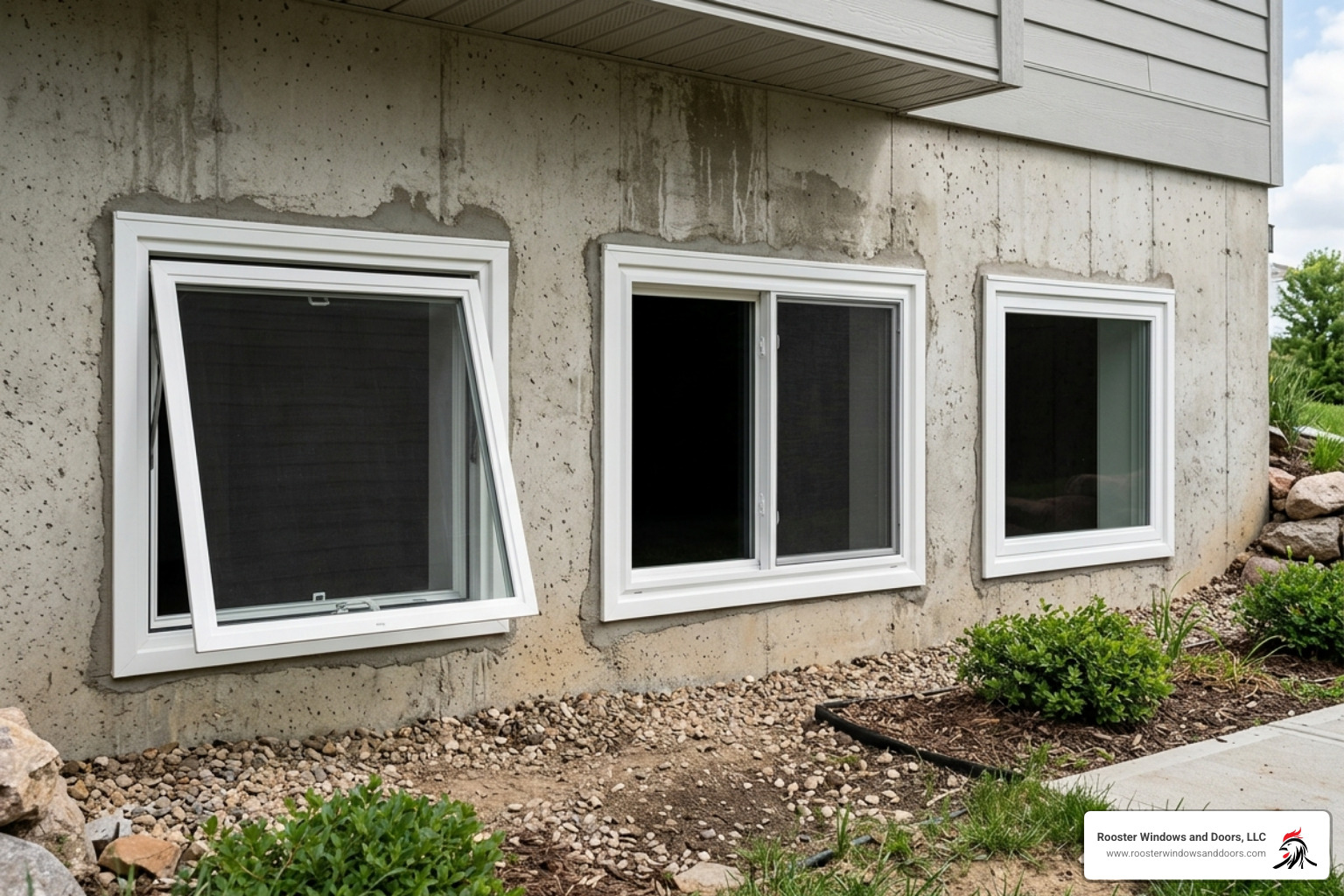
Here are the primary styles available for your foundation:
- Hopper Windows: These are the “classic” basement choice. They are hinged at the bottom and open inward from the top. They are fantastic for ventilation because they direct air into the room while keeping debris out.
- Sliding Windows: Just like the sliders in your living room, these move horizontally. They provide a great seal against the elements and are easy to operate in tight spaces where an inward-swinging window might hit an appliance or shelf.
- Fixed Units: If you only need light and don’t require airflow, fixed windows are the most energy-efficient option because they are permanently sealed.
- Casement Styles: These are hinged on the side and crank outward. While less common in standard basement openings, they are the gold standard for egress (emergency exit) windows because the entire sash opens wide.
- Awning Windows: These are hinged at the top and open outward. They are great for rainy climates because the glass acts as a little roof, allowing you to keep the window open for fresh air even during a light drizzle.
Choosing the right style depends on your specific needs. For more details on which might fit your home, check out our guide on Windows for Basement.
The Versatility of Custom Basement Windows: Hopper and Hinged Styles
In the Chicagoland area, the hopper window remains a top seller. Why? Because it is incredibly practical. Modern custom basement windows often feature high-quality PVC frames that won’t rot like the old wood frames found in historic Evanston homes, and they won’t rust like the steel frames common in 1950s builds.
The in-swing mechanism of a hopper window is designed for maximum airflow. Because the sash tilts in, it creates a “scoop” for fresh air. Furthermore, many of our custom PVC hinged windows feature multi-chambered frames that trap air to provide superior insulation. If you are looking for a brand that understands the unique needs of local foundations, you should definitely look into Park Ridge Products: The Basement Window Brand You Need to Know.
Specialized Solutions: Egress and Crawl Space Windows
Not all basement windows are just for “looking out.” Some are literally lifesavers. If you are converting a basement into a bedroom or a habitable living space, local building codes in Illinois require at least one egress window.
An egress window is a specific type of custom basement window that is large enough for a person (including a firefighter with an air tank) to climb through in an emergency. These often require a specialized casement or “in-swing” design to meet the minimum clear opening requirements.
On the other end of the spectrum, we have crawl space windows. These are often much smaller, designed primarily to keep out pests and moisture while providing a small amount of light. We also offer specialized solutions like hopper windows with integrated dryer vents, allowing you to exhaust your laundry appliances through the window frame without cutting an additional hole in your foundation wall. For a deep dive into safety requirements, read our Egress Basement Window Complete Guide.
Key Features of High-Performance Custom Windows
When you invest in custom basement windows, you aren’t just buying glass; you’re buying a technical system designed to protect your home’s foundation. In our experience at Rooster Windows and Doors, the difference between a “cheap” window and a “high-performance” window comes down to the materials and the engineering.
| Feature | Why It Matters |
|---|---|
| Virgin PVC Vinyl | Resists cracking, warping, and fading better than recycled vinyl. |
| Multi-Chamber Frames | Traps air inside the frame to increase strength and R-value insulation. |
| Fusion-Welded Corners | Ensures the frame is one solid piece, preventing leaks and separation. |
| Low-E Glass | Reflects heat back to its source, keeping you warm in winter and cool in summer. |
| Argon Gas Fill | A dense gas between panes that slows down heat transfer. |
| Intercept Spacers | Reduces condensation at the edges of the glass. |
High-quality windows, like the EverLast™ series, can achieve an R-value of 2.94. To put that in perspective, a standard single-pane window has an R-value of about 1.0. Upgrading to a custom unit nearly triples your insulation.
Beyond the window itself, you must consider the exterior. Custom basement windows are often paired with window well covers to keep out rain, snow, and leaves. Without proper sealing, even the best window can’t stop water from pooling against your foundation. Learn how to protect your investment with our tips on No More Drips: Easy Ways to Waterproof and Seal Your Basement Windows.
Navigating Egress Codes and Installation Requirements
Installing custom basement windows in a basement is significantly more complex than installing them on a second floor. Because the windows are below ground level, you are dealing with concrete foundations, soil pressure, and drainage issues.
If you are installing an egress window, the requirements are strict:
- Minimum Opening: Usually a minimum of 5.7 square feet of clear opening.
- Minimum Dimensions: A minimum height of 24 inches and a minimum width of 20 inches.
- Sill Height: The bottom of the window opening cannot be more than 44 inches from the floor.
- Window Well: If the window is below ground, the well must provide enough room for the window to open fully and for a person to climb out. It must also have a built-in ladder or steps if the well is deeper than 44 inches.
In many cases, installing these windows requires “concrete cutting.” This involves using a specialized diamond-blade saw to enlarge the existing opening in your foundation. It is a messy, precise job that requires professional expertise to ensure the structural integrity of your home remains intact. For a step-by-step look at how we handle these projects, see our Complete Basement Windows Install Guide.
Measuring for Your Custom Basement Windows
The “custom” in custom basement windows only works if the measurements are perfect. We always recommend measuring the “rough opening”—the actual hole in the concrete or wood frame—rather than the old window itself.
When measuring, you need to consider the jamb depth. Standard basement walls in the Chicagoland area can vary in thickness; some are 8 inches thick or more. If you order a window with a standard 3 1/4-inch frame, you’ll have a lot of exposed concrete on the inside. Custom windows can be ordered with extended jambs to create a finished look from the inside out.
You also need to decide if you need a “nailing flange” (common for new construction or when the siding is removed) or a “block frame” (common for masonry or concrete installations). For a detailed walkthrough, visit Measure Up: What You Need to Know About Basement Window Dimensions.
The Investment: Costs and Long-Term Value
Let’s talk numbers. While a basic stock hopper window might start as low as $199, a true custom basement window project involves more than just the unit price.
- Standard Custom Hopper: $250 – $650 per unit.
- Sliding or Fixed Custom Units: $279 – $400.
- Egress Window Units: $700 – $1,100 (unit only).
- Full Egress Installation (including concrete cutting and window well): $2,500 – $5,000+ depending on the complexity.
While the upfront cost is higher than a “quick fix,” the long-term value is undeniable. The U.S. Department of Energy notes that upgrading to energy-efficient windows in cold climates (like ours in Illinois) can cut energy bills by 10% to 25%. Beyond the monthly savings, a bright, dry, and code-compliant basement adds significant square footage to your home’s appraisal value. To see how these upgrades look in real homes, check out From Drab to Fab: Naperville’s Best Basement Window Upgrades.
Frequently Asked Questions about Custom Basement Windows
How long does it take to receive custom sized windows?
Generally, both standard and custom-sized basement windows share a similar production timeline. You can typically expect a shipping window of approximately 4 to 5 weeks from the time of order confirmation. Because these are manufactured to your specific dimensions in American factories, the process includes precision cutting, fusion welding, and quality testing before they arrive at your doorstep in Schaumburg or Waukegan.
Should I DIY or hire a professional for basement window installation?
While a handy homeowner might be able to swap out a small window in a wood-framed opening, we strongly advise against DIY for any project involving concrete cutting or egress compliance.
Cutting into a foundation wall is structurally risky. If done incorrectly, you can cause cracks in your foundation or compromise the support of the walls above. Furthermore, professional installers like us have the specialized tools to manage water drainage and ensure the window is perfectly leveled and sealed. Hiring Basement Window Replacement Contractors ensures the job is done right the first time and usually comes with a labor warranty that a DIY project lacks.
What maintenance is required for vinyl basement windows?
One of the best things about modern vinyl custom basement windows is how little work they require. Unlike old wood windows that need painting or steel windows that need wire-brushing and rust-proofing, vinyl just needs an occasional wipe-down with soap and water.
Many of our custom hopper and sliding models feature removable sashes. This means you can pop the window out of the frame entirely, take it to a utility sink to wash it, and pop it back in. It also makes it easy to pass large items (like a new water heater or gym equipment) into the basement without struggling through a narrow door. Plus, most high-quality vinyl windows come with a lifetime warranty on the frame and hardware.
Conclusion
Your basement shouldn’t feel like a dark, damp bunker. By choosing custom basement windows, you are investing in the health, safety, and beauty of your home’s foundation. Whether you are looking for a simple hopper to improve air circulation in your laundry room or a full egress system to turn your basement into a guest suite, Rooster Windows and Doors, LLC is here to help.
We pride ourselves on providing the Chicagoland area—from Libertyville to Joliet—with flawless, energy-efficient installations and a wide variety of options to suit your specific needs. Don’t settle for “close enough” when it comes to your home. If you’re ready to see your foundation in a whole new light, Upgrade to Custom Hopper Windows today and experience the difference that professional craftsmanship makes.
