

Why Egress Window Design Is More Than Just a Safety Checkbox
Egress window design is one of the most important — and most overlooked — decisions a homeowner makes when finishing a basement or adding a bedroom.
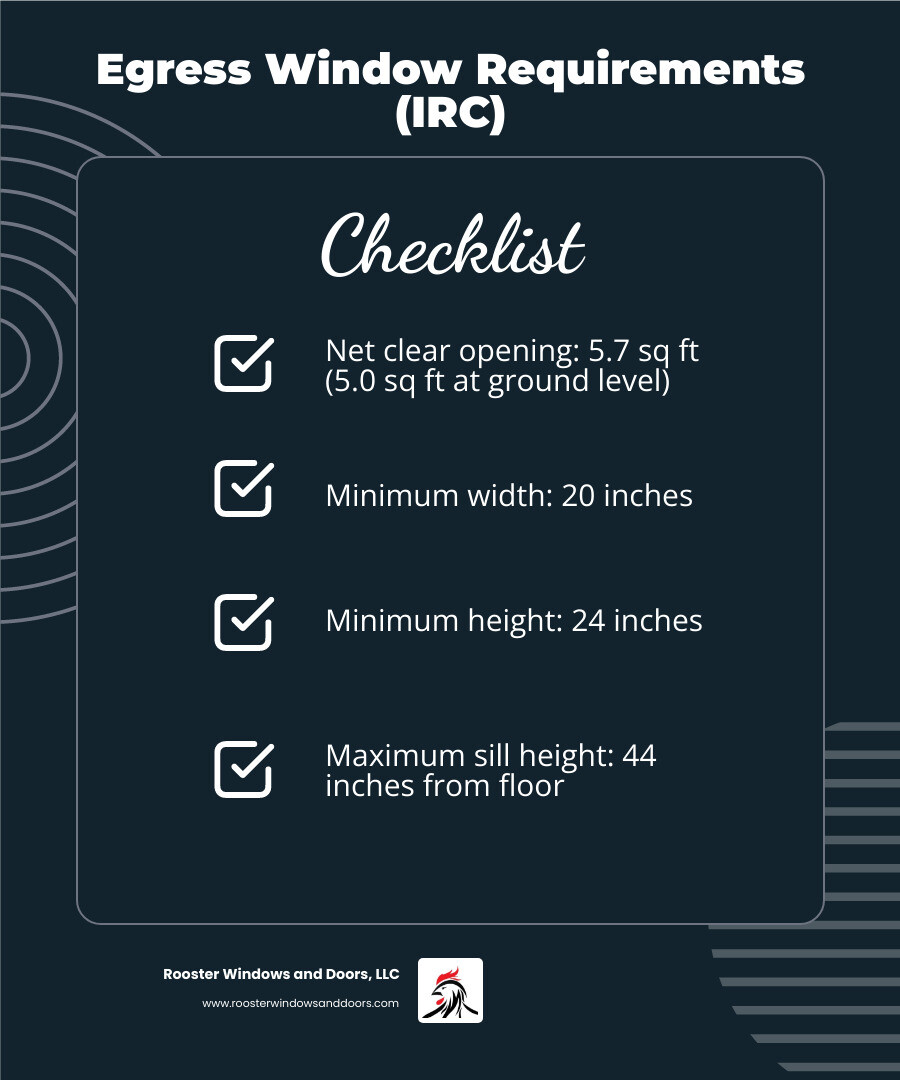
Here’s a quick overview of what makes a window qualify as an egress window:
| Requirement | Minimum Standard (IRC) |
|---|---|
| Net clear opening area | 5.7 sq ft (5.0 sq ft at ground level) |
| Minimum width | 20 inches |
| Minimum height | 24 inches |
| Maximum sill height | 44 inches from finished floor |
| Window well area | 9 sq ft (min. 36″ x 36″) |
| Best window style | Casement (opens fully) |
But here’s the thing: egress windows don’t have to look like an afterthought. Done right, they bring in natural light, increase your home’s value, and can even become a design feature you’re proud of.
The stakes are real. According to the National Fire Protection Association, the average home fire can make a room unsurvivable in as little as 3 minutes. That small window — literally — can be the difference between escape and tragedy.
Whether you’re converting a basement into a legal bedroom or simply upgrading old, small windows, there’s a wide range of styles, materials, and well designs to choose from. This gallery walks you through the best of them.
I’m Piotr Wilk, and through over two decades of residential window and door installation across the Chicagoland area with Rooster Windows and Doors, LLC, I’ve seen how thoughtful egress window design transforms both the safety and the appeal of a home. Let’s explore the concepts that work best.
Glossary for Egress window design:
Essential Standards for Compliant Egress Window Design
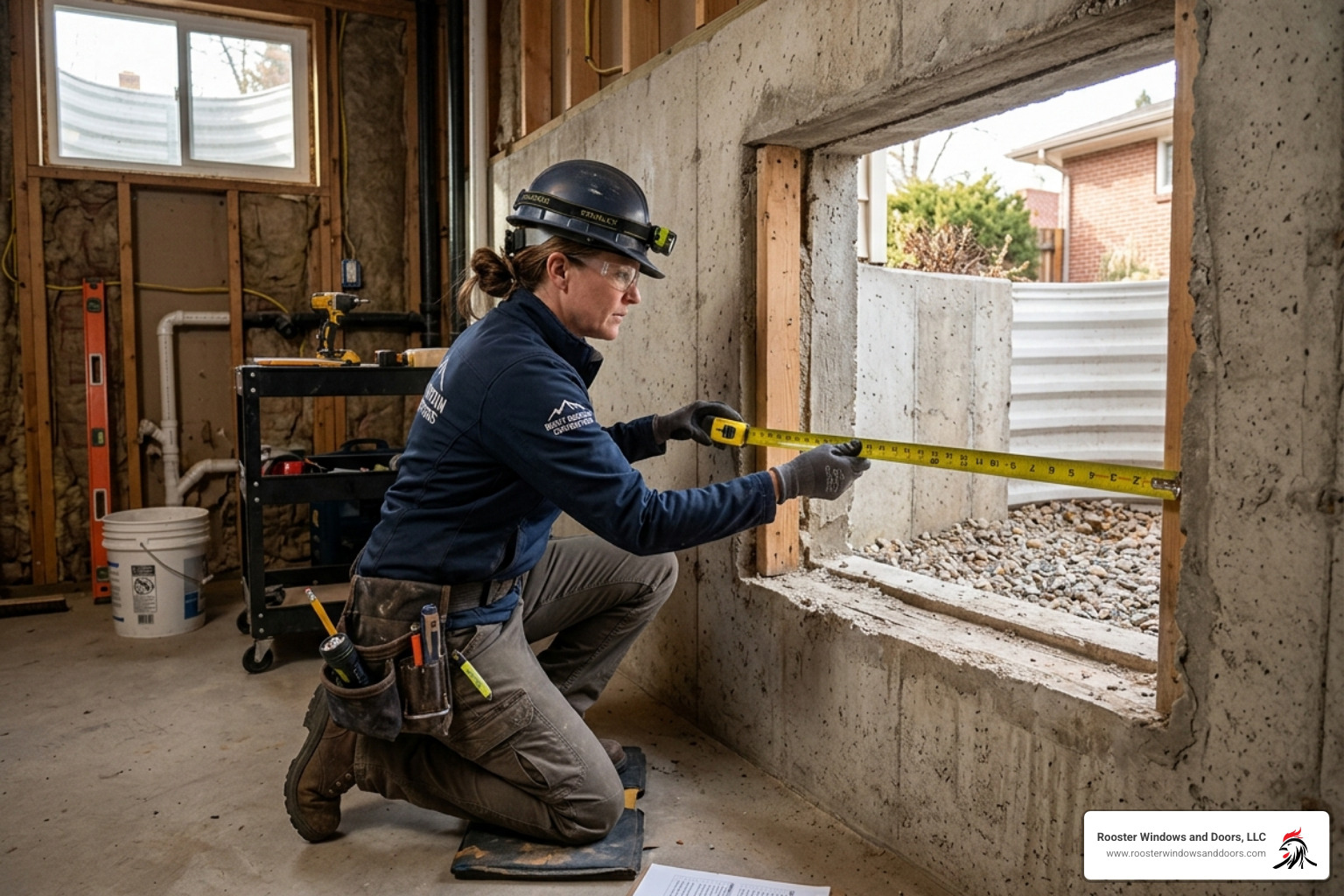
When we talk about egress window design, the “design” part isn’t just about aesthetics; it’s about life-saving geometry. The International Residential Code (IRC) Section R310 serves as the blueprint for safety. If a window doesn’t meet these specific measurements, it isn’t an egress window—it’s just a window that happens to be in a basement.
One of the most frequent points of confusion we encounter at Rooster Windows and Doors is the “Net Clear Opening.” This refers to the actual free space created when the window is fully opened. It is not the size of the glass, nor is it the “rough opening” in the wall. It is the literal hole a person (and a firefighter in full gear) can climb through.
To be compliant, the window must offer a net clear opening of at least 5.7 square feet. This ensures that in a smoke-filled emergency, an occupant can exit and a rescuer can enter without struggle. Additionally, the sill height cannot be more than 44 inches from the finished floor. If your window is higher than that, you’ll need a permanent step or ladder to meet code.
For a deeper dive into these specific numbers, check out our guide on Don’t Get Boxed In: Understanding the 57 sq ft Egress Window Rule.
IRC and Regional Code Variations
While the IRC provides the national baseline, regional variations are common. For our neighbors in the Chicagoland area, including places like Naperville, Aurora, and Schaumburg, local municipalities often follow the most recent IRC updates, but always check for local amendments.
In Pennsylvania, for instance, the IRC 2018 standards are widely used, but local counties like Berks or Montgomery may have specific tweaks for older homes. If you are looking across the border to Canada, the National Building Code (NBCC) requires a minimum clear opening of 0.35 m² (roughly 3.8 sq. ft.), with no dimension less than 380 mm (15 inches).
Regardless of where you live, a permit is almost always required for egress window design projects because they involve structural changes to your foundation. We always recommend verifying these Basement Window Dimensions with your local building department before the first shovel hits the dirt.
Minimum Sizing and Net Clear Openings
To hit that 5.7 square foot requirement, you can’t just pick any small window. There is a mathematical “sweet spot” you have to find:
- Minimum Width: 20 inches.
- Minimum Height: 24 inches.
Here is the catch: a window that is exactly 20″ wide and 24″ high only provides 3.33 square feet of opening. To reach 5.7 square feet, a 20-inch wide window actually needs to be 42 inches high. Conversely, a 24-inch high window needs to be 34.2 inches wide.
There is a slight exception for “grade-floor” windows (windows where the sill is at or below the exterior ground level), which only require 5.0 square feet of net clear opening. However, for most basement applications, the 5.7 rule is the gold standard.
Choosing the Best Styles for Your Egress Window Design
The style of window you choose dictates how much light enters your room and, more importantly, how easily you can get out. In egress window design, not all windows are created equal. Some styles are naturally “egress-friendly,” while others require massive wall openings to meet the same safety standards.
We generally guide our clients toward styles that offer the most unobstructed escape route. A well-chosen window provides more than just a fire exit; it offers ventilation to keep a basement from feeling “musty” and floods the space with natural light, making a below-grade room feel like a true living area. For more inspiration, see our collection of Windows for Basement.
Modern Window Styles for Egress Window Design
- Casement Windows: These are the “star players” of egress. Because they hinge at the side and swing outward like a door, nearly the entire window area becomes a clear opening. This allows you to meet code with a much smaller overall window size compared to other styles.
- Sliding Windows: These are popular because they are easy to operate, but they have a drawback: only half the window is open at any time. To meet the 5.7 sq. ft. requirement, a slider usually needs to be quite large—often double the width of a casement.
- Double-Hung Windows: These are classic but can be problematic for basements. Since the sashes overlap, you lose more than half of the total area to the frame and glass. A double-hung window often needs to be nearly 5 feet tall to qualify for egress.
- Hopper Windows: These hinge at the bottom and lean in. While common in older basements, most standard hoppers are too small for egress. However, specialized egress-sized hoppers do exist.
For a comprehensive breakdown of these options, visit our Egress Basement Window Complete Guide.
Energy Efficiency and Material Selection
At Rooster Windows and Doors, we prioritize energy efficiency. Basements are naturally prone to temperature swings and moisture. Your egress window design should incorporate:
- Low-E Glass: Reflects infrared light to keep heat in during winter and out during summer.
- Argon Gas Fill: An insulating gas between panes that reduces thermal transfer.
- Vinyl vs. Fiberglass: Vinyl is the budget-friendly, low-maintenance king. Fiberglass, however, offers superior durability and can withstand extreme temperature changes without expanding or contracting as much as vinyl.
When selecting brands, we often look for Park Ridge Products and other high-quality manufacturers that specialize in the rugged requirements of basement environments.
Creative Window Well Concepts to Elevate Your Basement
If the window is the “exit,” the window well is the “pathway.” A standard corrugated metal well is functional, but it’s often described as looking like a “tin can.” Modern egress window design allows for much more creativity.
Technically, the well must provide at least 9 square feet of horizontal area, with a minimum projection of 36 inches from the wall. This ensures there is enough room for a person to climb out and for a ladder to be used. But within those rules, you can create something beautiful. If you’re looking for specialists to help, check out Window Well Companies Near Me.
Aesthetic Materials for Egress Window Design Wells
- Tiered Stone Walls: Instead of one deep hole, create “steps” using natural stone or pavers. This allows for planting flowers at different levels and lets significantly more sunlight into the basement.
- Pressure-Treated Timber: Timber wells provide a rustic, natural look that blends perfectly with backyard landscaping and wooden decks.
- Decorative Brick: For a traditional look that matches your home’s exterior, brick wells are incredibly durable and classic.
- Fiberglass Liners: These are one-piece units that often mimic the look of stacked stone. They are rust-proof, easy to install, and very sturdy.
Safety Features: Ladders, Covers, and Drainage
Safety doesn’t stop at the window frame. If your window well is deeper than 44 inches, the IRC requires a permanent ladder or steps. The ladder must be at least 12 inches wide and project at least 3 inches from the wall, but no more than 6 inches into the required 36-inch clearance.
Drainage is the most critical technical component. Without a proper drain connected to your home’s weeping tile or a French drain system, your window well can become a giant aquarium during a heavy Illinois thunderstorm. We always recommend a layer of gravel at the bottom to facilitate drainage and a high-quality cover to keep out debris, snow, and small animals.
Learn more in our Egress Window Installation Complete Guide.
Professional Installation, ROI, and Maintenance
Installing an egress window is not your typical weekend DIY project. It involves excavating thousands of pounds of dirt and, most importantly, cutting a large hole in your home’s structural foundation.
At Rooster Windows and Doors, we use specialized hydraulic or electric concrete saws to ensure a clean, precise cut. This is vital for maintaining the structural integrity of your home. If the cut is messy or the header isn’t reinforced properly, you risk cracks in your foundation or even structural failure. As we like to say, Don’t Get Saw-ry, Get Smart about foundation cutting.
Maximizing Home Value and ROI
One of the best arguments for investing in a high-quality egress window design is the return on investment (ROI). By adding an egress window to a basement, you can legally classify a basement room as a bedroom.
In the real estate market, an extra bedroom can add between $10,000 and $20,000 to your property value, depending on your location in the Chicagoland area. It also increases the “habitable square footage” of your home, making it much more attractive to future buyers. For the facts on how this works, see Egress Windows and Home Square Footage.
DIY vs. Professional Installation Costs
The average cost to professionally install an egress window is approximately $4,167, with most projects falling between $2,632 and $5,706. While a DIY approach might seem cheaper, the risks are substantial.
- Utility Lines: You must have utility companies mark underground lines before you dig.
- Waterproofing: Professionals ensure the window is flashed and sealed correctly to prevent leaks.
- Code Compliance: A pro knows exactly what the inspector is looking for.
For a full breakdown of what goes into the price, check out our article on Egress Window Installation Cost.
Frequently Asked Questions about Egress Window Design
How many egress windows are required in a basement?
The rule is simple: you need at least one egress window in the basement as a whole, plus one in every room used for sleeping. If you have a large basement with two bedrooms and a family room, you would typically need three egress windows to be fully compliant.
Can I use a sliding window for egress?
Yes, but size matters. Because sliding windows only open halfway, the entire unit must be large enough so that the opened half meets the 5.7 sq. ft. requirement. This usually means the window will be at least 4 to 5 feet wide.
What are the most common egress installation mistakes?
The “Big Three” mistakes are:
- Measuring the Frame instead of the Opening: Failing the inspection because the net clear area is too small.
- Poor Drainage: Not connecting the well to a drain, leading to basement flooding.
- Incorrect Sill Height: Placing the window too high (over 44 inches) without a permanent step.
Conclusion
At Rooster Windows and Doors, LLC, we believe that safety and style should go hand-in-hand. Whether you are in Libertyville, Naperville, or anywhere in the greater Chicagoland area, our goal is to provide high-quality, flawless, and energy-efficient installations that protect your family and enhance your home.
A well-executed egress window design is an investment in peace of mind. It turns a dark, “emergency-only” space into a bright, legal, and beautiful part of your home. If you’re ready to transform your basement, we’re here to help with professional Egress Window Installation. Let’s make your home safer and more stylish, one window at a time.
