

Why a New Egress Window Is More Than Just a Code Requirement
A new egress window is a large, operable window that meets building code minimums so occupants can escape — and firefighters can enter — during an emergency.
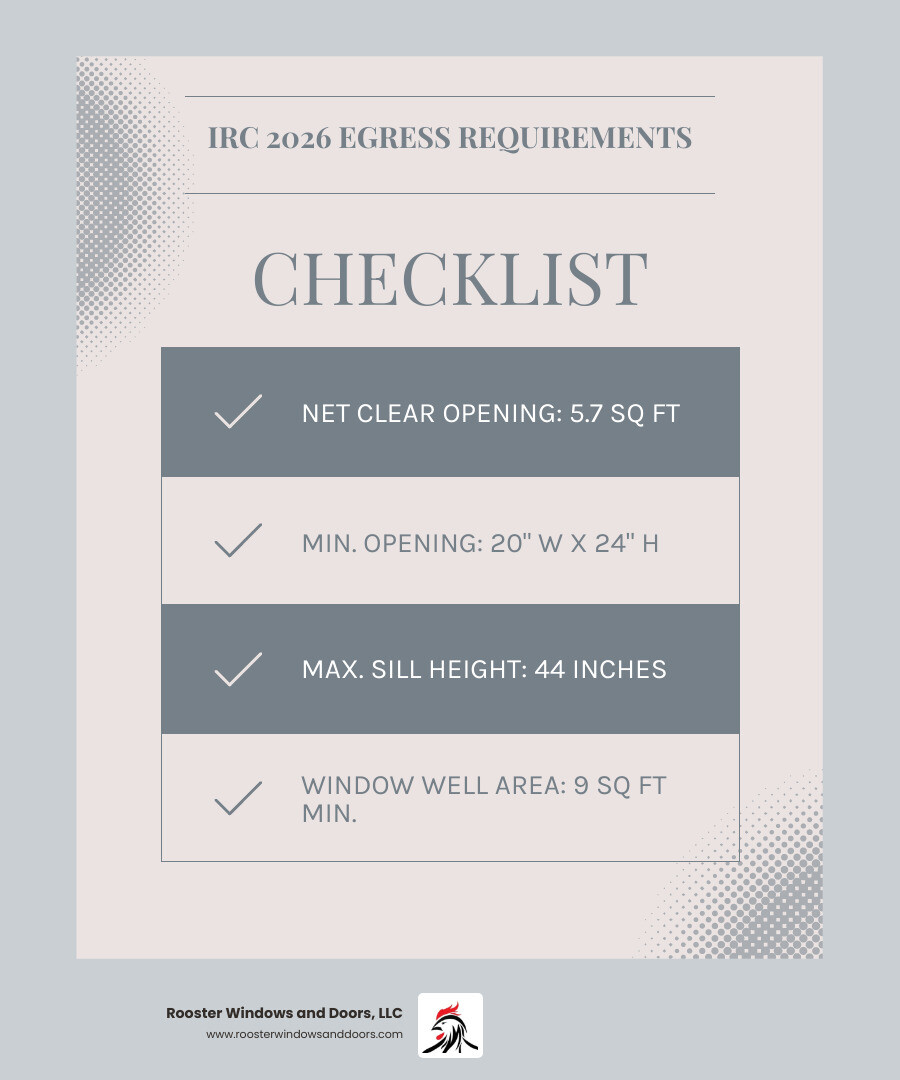
Here is what you need to know at a glance:
| Requirement | Minimum Standard (IRC 2026) |
|---|---|
| Net clear opening | 5.7 sq ft (5.0 sq ft at grade level) |
| Opening width | 20 inches |
| Opening height | 24 inches |
| Maximum sill height | 44 inches from finished floor |
| Window well area | 9 sq ft minimum |
| Window well projection | 36 inches from foundation wall |
| Ladder required if well depth exceeds | 44 inches |
The window must open from the inside without keys or tools.
Every sleeping room and any habitable basement space requires at least one compliant egress opening. Skip it, and you risk failed inspections, voided insurance, and — most importantly — a blocked escape route in a fire.
Beyond safety, a properly installed egress window brings real daylight and fresh air into a basement. It can also turn an unfinished bonus room into a legal bedroom, adding an estimated $10,000–$20,000 to your home’s value.
I’m Piotr Wilk, and with over two decades of residential window installation experience across the Chicagoland area, I’ve helped countless homeowners navigate the specific requirements for a new egress window — from concrete cutting to final inspection. Let’s walk through everything you need to know to get it right.
New egress window vocabulary:
Understanding the 2026 IRC Requirements for a New Egress Window
When we talk about installing a new egress window, we aren’t just talking about aesthetics. We are talking about the International Residential Code (IRC), specifically Section R310. As of April 2026, these standards are non-negotiable for any basement bedroom or habitable living area in the Chicagoland area.
The most important concept to grasp is the “net clear opening.” This isn’t the size of the glass or the rough opening in your foundation; it is the actual, unobstructed space that remains when the window is fully open. Think of it this way: could a firefighter in full gear, carrying an oxygen tank, crawl through that space? If the answer is “maybe,” then the window probably doesn’t meet code.
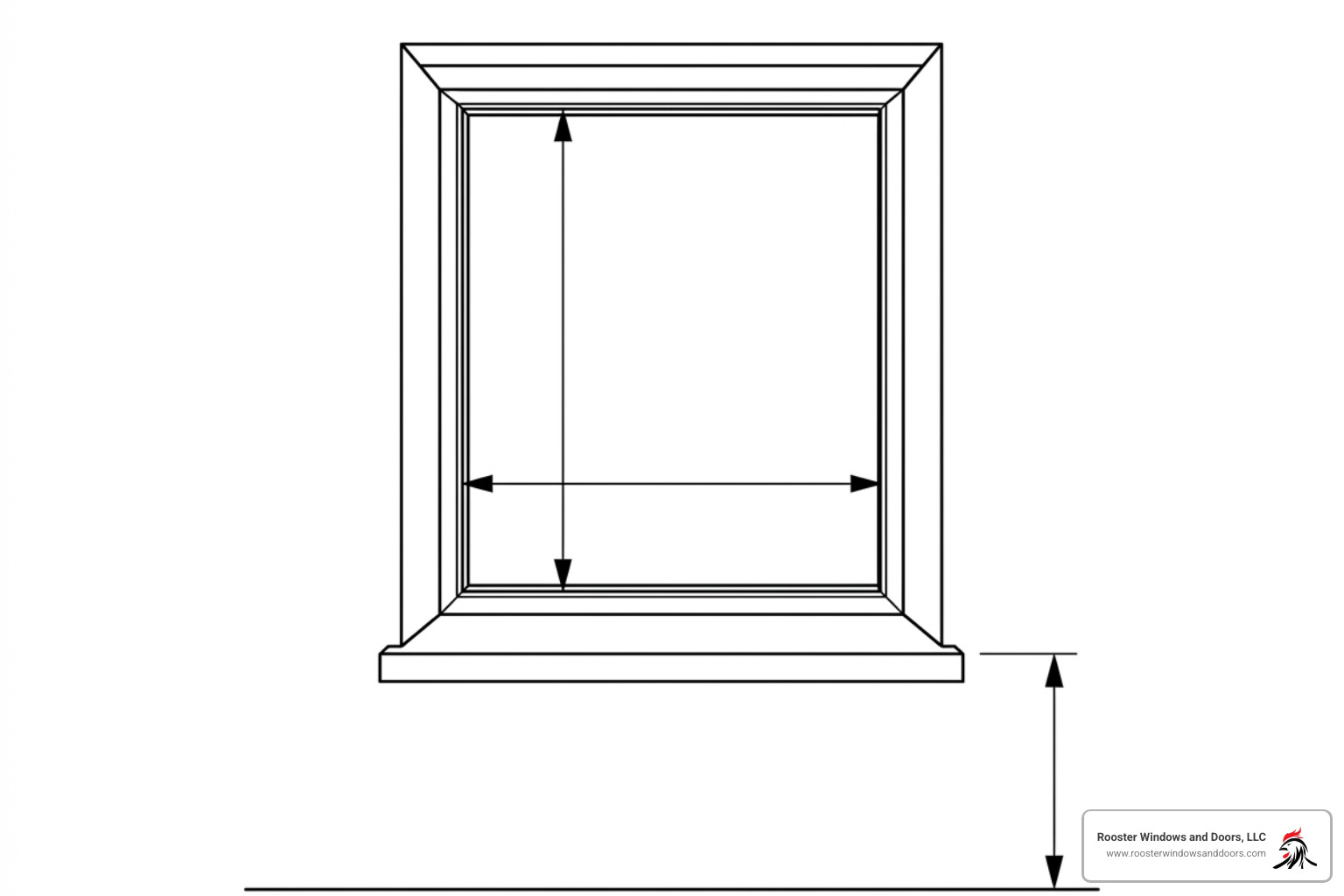
To stay compliant, your new egress window must meet these four critical dimensions:
- Net Clear Opening: At least 5.7 square feet. There is a slight exception for ground-floor windows (grade level), which can be 5.0 square feet because the drop to the ground is shorter.
- Minimum Width: 20 inches.
- Minimum Height: 24 inches.
- Maximum Sill Height: 44 inches from the finished floor.
One of the most common mistakes we see is homeowners buying a 36″ x 36″ window and assuming it works. Mathematically, 3×3 is 9 square feet, right? Wrong. Once you account for the frame and the way the sashes overlap, many sliding or double-hung windows of that size actually fail the 5.7 sq ft rule. To avoid this, understand the 5.7 sq ft egress window rule before you start cutting into your foundation.
For more technical details on these measurements, you can consult the 2026 Guide to Egress Window Size Requirements for Home Safety. In our experience working from Libertyville to Naperville, inspectors are meticulous about these numbers. Even being off by half an inch can mean a failed inspection and a very expensive redo.
Essential Components: Window Wells and Safety Ladders
If your basement is below grade—which most are in Illinois—the window alone isn’t enough. You need a window well system that allows for a safe exit to the surface. A new egress window well is essentially an outdoor room for your window, and it has its own set of strict IRC rules.
The well must provide at least 9 square feet of clear floor area and project at least 36 inches away from the foundation wall. This ensures there is enough room for a person to climb out comfortably. Furthermore, if the well is deeper than 44 inches—which is common in our region due to deep foundations—a permanent ladder or steps must be installed.
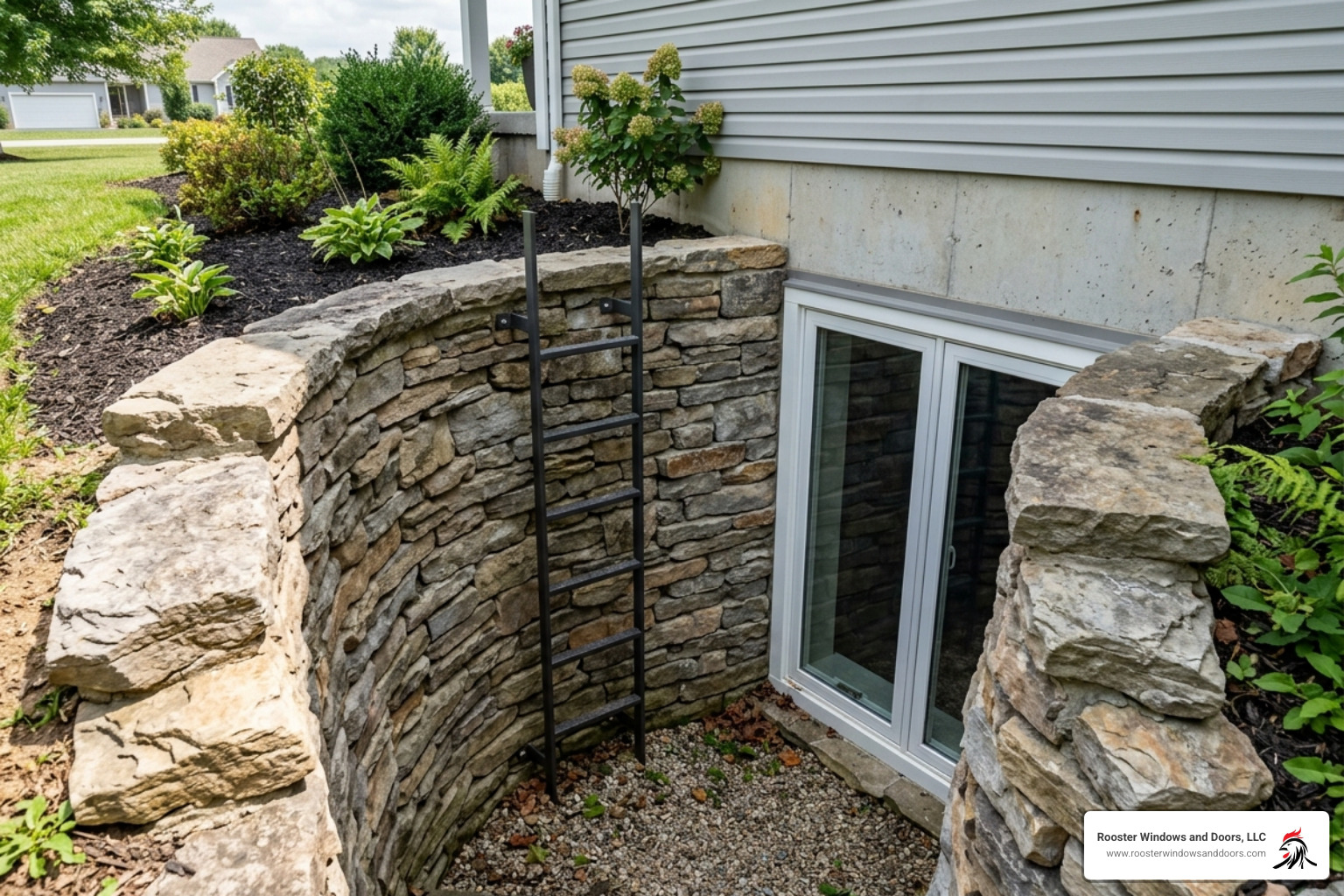
The ladder itself cannot be an afterthought. It must be permanently attached, at least 12 inches wide, and cannot protrude more than 6 inches into the required 36-inch projection of the well. We often recommend stone-textured or high-quality galvanized steel wells because they offer durability (20-30 years) and look much better than a basic corrugated metal “tin can.”
Drainage is the silent hero of a successful installation. Without a proper drainage system, your new window well can quickly turn into a backyard aquarium during a heavy Illinois downpour. We always connect the well drainage to the home’s existing weeping tiles or foundation drain system, filling the base with at least 12 inches of clean gravel. If you’re looking for specialists to handle this, searching for window well companies near me is a great place to start.
For a deeper dive into these exterior requirements, check out the Egress Window Requirements 2026: Sizes, Costs & Installation Guide.
Selecting and Installing Your New Egress Window
Choosing the right style for your new egress window is about balancing functionality with code compliance. Not all window types are created equal when it comes to saving lives.
| Window Type | Egress Suitability | Pros | Cons |
|---|---|---|---|
| Casement | Excellent | 100% of the opening is usable; best for small spaces. | Requires interior/exterior clearance for the sash. |
| Sliding | Good | Easy to operate; traditional look. | Needs to be very large to meet the 5.7 sq ft rule. |
| Double-Hung | Poor | Familiar style. | Only half the window opens; rarely meets egress in basements. |
| In-Swing | Specialized | Great for tight wells. | Can interfere with furniture or curtains inside. |
At Rooster Windows and Doors, we prioritize energy efficiency alongside safety. Our installations typically feature Low-E glass and argon gas fills, which help regulate basement temperatures and prevent the “drafty basement” syndrome. We also use high-quality vinyl frames that won’t rot or warp in the high-moisture environment of a basement.
When we install a new egress window, we aren’t just swapping glass. We are often creating a new structural opening. This requires a structural header to support the weight of the house above the new cut. Maintaining foundation integrity is our top priority, which is why we follow a comprehensive basement window replacement guide 2026.
Benefits of a Casement New Egress Window
In basement safety, the casement window is king. Because the entire sash cranks open and swings out of the way, you get 100% of the window area for egress. This allows us to install a smaller overall window frame while still meeting the 5.7 sq ft requirement—saving you money on concrete cutting.
Casement windows also offer superior energy efficiency. When locked, the sash creates a mechanical seal against the frame, significantly reducing air infiltration. They also provide excellent ventilation, catching side breezes and directing them into your home. For more on why this is the preferred choice, see our egress basement window complete guide.
Professional Installation of a New Egress Window
The installation process for a new egress window is a major construction project. It begins with excavation, often moving several tons of dirt by hand or mini-excavator. Then comes the most nerve-wracking part for most homeowners: cutting the concrete.
We use high-powered hydraulic or electric saws with diamond-tipped blades to make precision cuts through 8 to 10 inches of poured concrete. To keep your home clean, we use wet-saw techniques and industrial vacuums to manage dust and slurry. Once the opening is cut, we install a rot-proof buck frame, the window itself, and the well.
Waterproofing is the final, crucial step. We use high-grade sealants and flashing to ensure the unit is airtight and watertight. We also handle the entire permit acquisition process with your local municipality, ensuring the project is legal from start to finish. You can find more details in our egress window installation complete guide.
Investment and Value: Costs vs. ROI
Installing a new egress window is an investment in both safety and property value. On average, a professional installation in the Chicagoland area ranges from $2,500 to $6,500 per window.
Here is a typical cost breakdown:
- Window Unit: $300 – $900 (depending on style and energy features).
- Concrete Cutting: $1,500 – $3,500 (includes labor and specialized equipment).
- Excavation and Labor: $1,000 – $2,500.
- Window Well and Cover: $500 – $1,200.
While these numbers might seem high, the return on investment (ROI) is impressive. By adding a compliant egress window, you can legally classify a basement room as a bedroom. In markets like Lake Forest or Buffalo Grove, an extra bedroom can increase your home’s appraisal value by $10,000 to $20,000. That is a 200% to 300% return on your investment.
Beyond the money, there is the “peace of mind” factor. Knowing your family has a clear escape route is priceless. If you’re planning your budget, take a look at our detailed breakdown of egress window installation cost.
Frequently Asked Questions about Egress Windows
Do all basement rooms need egress windows?
Not necessarily. According to the IRC, an egress window is required in every room used for sleeping (bedrooms). However, the code also states that at least one egress opening is required in any “habitable basement space.” If your basement is just for storage or housing a furnace, you might not need one. But if you have a family room, office, or gym, most local inspectors will require a new egress window to ensure safety. For a full breakdown, see our basement windows complete guide.
Can I install an egress window myself?
While a very skilled DIYer might be able to handle the window installation, we strongly advise against DIY concrete cutting and structural modification. Cutting into your foundation without proper shoring can lead to structural failure. Additionally, many DIY projects fail inspection because of minor sizing errors or improper drainage. As we like to say: egress window cutting: Don’t get saw-ry, get smart—hire a professional who carries the right insurance and equipment.
Do window well covers need to be removable?
Yes! If you install a cover to keep out debris, snow, or neighborhood critters, it must be easily removable from the inside without the use of a key, tool, or special knowledge. It should require no more than 30 pounds of force to open. We recommend clear polycarbonate covers because they allow 90% of natural light to reach the basement while keeping the well dry. Learn more about your options for covers for basement windows.
Conclusion
A new egress window is the single most important upgrade you can make to a finished basement. It bridges the gap between a “finished storage area” and a safe, legal, and light-filled living space. Whether you are in Arlington Heights, Evanston, or anywhere in the greater Chicago area, staying compliant with the 2026 codes is essential for your family’s safety and your home’s resale potential.
At Rooster Windows and Doors, LLC, we pride ourselves on providing flawless, energy-efficient installations that meet every local requirement. We don’t just “put in windows”; we create engineered escape systems that protect your home and your loved ones.
Ready to transform your basement and secure your home? Schedule your egress window installation with us today. We serve customers from Waukegan to Crystal Lake and everywhere in between, ensuring your project is done right the first time. Don’t get stuck in the basement—let us bring the light in.
