

Measure Up: What You Need to Know About Basement Window Dimensions
Why Basement Window Sizes Matter for Safety and Comfort
Understanding basement window sizes is critical for both legal compliance and practical home function. Whether you’re finishing a basement, adding a bedroom, or replacing old windows, choosing the right dimensions affects emergency safety, natural light, ventilation, and your home’s resale value.
Quick Reference: Basement Window Size Requirements
| Purpose | Minimum Width | Minimum Height | Minimum Area | Maximum Sill Height |
|---|---|---|---|---|
| Egress (bedroom/habitable) | 380 mm (15 in) | 380 mm (15 in) | 0.35 m² (3.77 sq ft) | 1.5 m (4.9 ft) |
| Standard (non-egress) | 29–32 in | 14–24 in | No minimum | No maximum |
Common Standard Sizes:
- Hopper windows: 32 in × 14 in, 32 in × 22 in
- Slider windows: 32 in × 16 in, 48 in × 24 in
- Glass block: 18 in × 18 in, 24 in × 24 in
Egress windows must meet strict National Building Code requirements for any basement bedroom or habitable space. The unobstructed opening—not the frame size—determines compliance. Provincial codes in British Columbia, Ontario, and Alberta add their own variations, particularly for sill height limits.
I’m Piotr Wilk, and over two decades of residential window installation in the Chicagoland area has taught me that understanding basement window sizes before you cut concrete saves homeowners thousands in retrofitting costs. Whether you’re working with unfinished storage space or creating a legal bedroom, getting the dimensions right the first time prevents inspection failures and keeps your family safe.
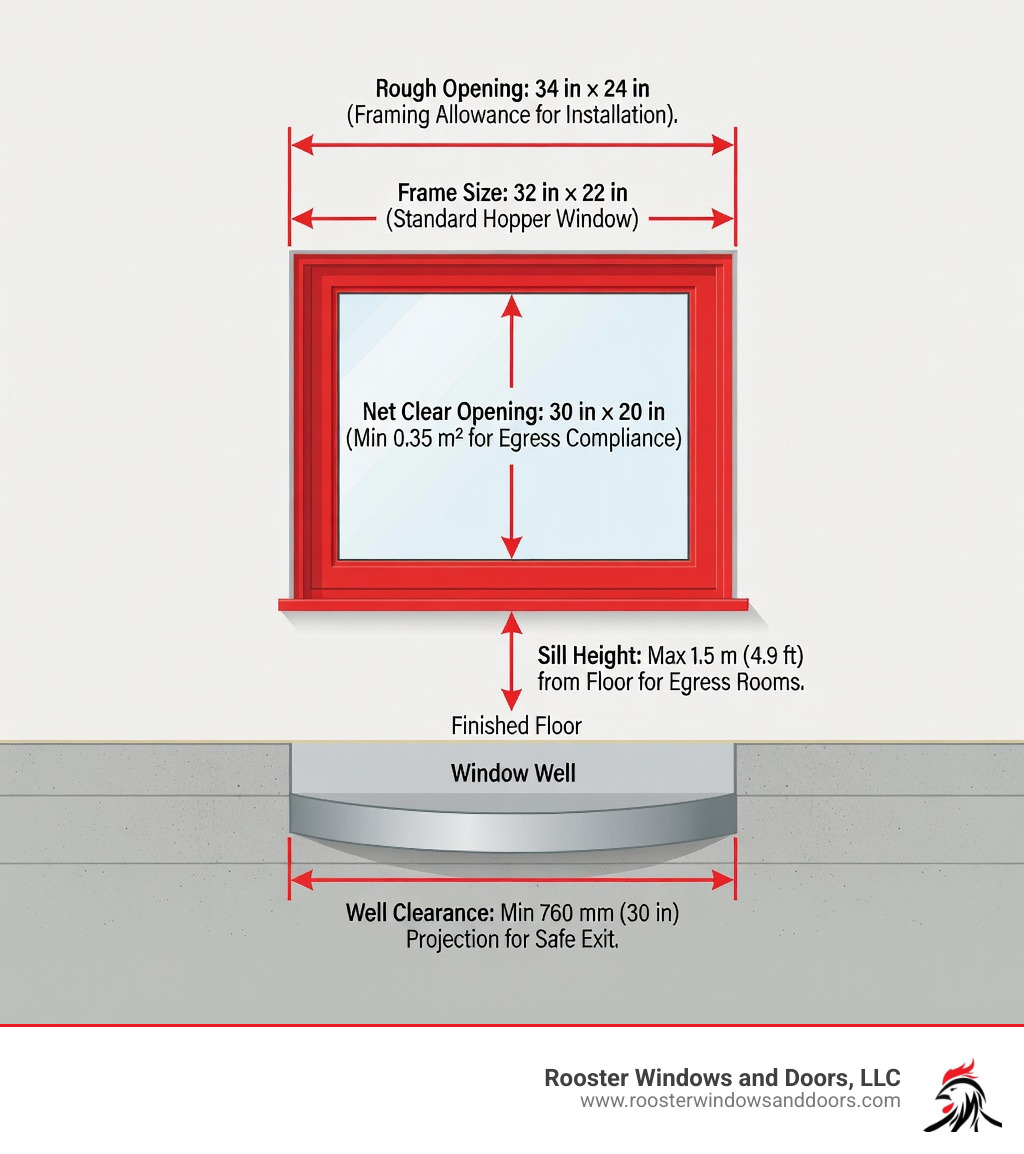
Learn more about basement window sizes:
Standard Basement Window Sizes for Non-Egress Spaces
When we talk about “standard” basement window sizes, we are usually referring to the smaller units found in unfinished basements used for storage, laundry, or utility rooms. These windows aren’t designed for someone to climb through in an emergency; rather, their job is to provide just enough light to prevent the basement from feeling like a tomb and enough ventilation to keep the air from getting stale.
In the Chicagoland area, from Libertyville to Elgin, we see these standard sizes in older bungalows and modern builds alike. Because these aren’t meant for escape, the dimensions are much more compact.
Typical Dimensions by Window Type
Different styles of windows come in different “off-the-shelf” sizes. If you are replacing a window in an existing masonry opening, you’ll likely find one of these standard sizes fits the bill:
| Window Type | Common Widths | Common Heights |
|---|---|---|
| Hopper Windows | 31 in, 32 in | 14 in, 18 in, 22 in |
| Sliding Windows | 32 in, 36 in, 48 in | 14 in, 16 in, 24 in |
| Glass Block | 18 in, 24 in, 32 in | 14 in, 18 in, 24 in |
Hopper Windows
The hopper window is the classic basement choice. It is horizontally oriented and hinges at the bottom, opening inward from the top. A standard width is 31 inches, with heights ranging from 13 to 23 inches. These are excellent for moisture control in bathrooms or laundry areas because they can be left cracked open to let steam out.
Sliding Windows
Sliders are common in slightly larger basement openings. They feature two sashes that slide side-to-side. Popular sizes include 32 in. x 14 in. and 32 in. x 22 in. While they offer great light, keep in mind that only half of the window is ever “open” at one time, which limits airflow compared to a hopper.
Glass Block
For those prioritizing security and privacy, glass block is a go-to. While these don’t typically “open” unless they have a small built-in vent, they are incredibly durable. Common sizes include 18 in. x 18 in. or 32 in. x 14 in.
If you’re curious about the full range of options for your lower level, our basement windows complete guide covers everything from materials to energy efficiency.

Egress Requirements: Legal Basement Window Sizes in Canada
If you are planning to build a bedroom in your basement or transform the space into a “habitable” area (like a family room or home office), the rules change entirely. You can no longer use those tiny hopper windows. You need an egress window.
The National Building Code of Canada (NBC) sets the baseline for safety. The logic is simple: if there’s a fire, and the stairs are blocked, you need a way out—and a firefighter in full gear needs a way in.
To be considered a legal egress window, the unit must meet three specific math requirements:
- Minimum Area: The unobstructed opening must be at least 0.35 square meters (3.77 square feet).
- Minimum Dimension: Neither the height nor the width of the opening can be less than 380 mm (15 inches).
- Operability: The window must be able to open fully from the inside without the use of tools, keys, or special knowledge.
It is a common mistake to think that if the window frame is large enough, you are safe. That’s not true. Code inspectors look at the “net clear opening”—the actual space you can crawl through. For more on this, check out our egress window installation complete guide.
Provincial Variations in Basement Window Sizes
While the NBC provides the baseline, different provinces have their own tweaks. If you’re looking at requirements across Canada, it’s important to note how sill height—the distance from the floor to the bottom of the window—varies.
- British Columbia: Typically follows the NBC baseline of a 1.5 m (4.9 ft) maximum sill height.
- Ontario: Stricter standards often require a sill height of no more than 1 m (39.37 inches).
- Alberta: Generally allows a sill height up to 1.18 meters.
In the United States, specifically in our service areas like Arlington Heights, IL and Chicago, we often follow the International Residential Code (IRC), which specifies a maximum sill height of 44 inches (1.12 m). If your window is higher than this, you may need to install a permanent step or bench to meet code. Knowing these specifics is vital because they directly impact the egress window installation cost.
Measuring the Clear Opening for Basement Window Sizes
Measuring for egress is the most common place where DIY projects go wrong. We have seen many homeowners buy a beautiful 36″ x 36″ window, only to find it fails inspection because the “clear opening” wasn’t calculated correctly.
How to measure accurately:
- Open the window completely.
- Measure the narrowest width between the jambs (the side frames).
- Measure the height from the top of the sill to the bottom of the sash.
- Multiply these two numbers. If the result is less than 0.35 m² (3.77 sq ft), it fails.
Common Measurement Errors:
- Hardware Obstructions: If the window crank or a handle sticks out into the opening, that space must be subtracted from your measurement.
- Sash Thickness: In sliding windows, the sash that stays in the frame often blocks a portion of the opening.
- Rough Opening vs. Net Opening: The “rough opening” is the hole in your wall. The “net clear opening” is the actual escape path.
If you’re unsure how to prep your space, our guide on how to install new basement window provides a step-by-step breakdown of the technical side.
Choosing the Right Window Type for Egress Compliance
Not all windows are created equal when it comes to meeting basement window sizes for egress. Some styles are “space-efficient,” meaning they provide a large opening relative to their overall size, while others are “space-hogs.”
Casement Windows
These are the gold standard for egress. Because the entire sash swings open (like a door), almost the entire window area becomes a clear opening. This allows you to meet code with a much smaller overall window. A casement window that is 30 inches wide by 48 inches tall is a very popular choice for egress retrofits.
Horizontal Sliders
Sliders are great for light, but only half the window opens. To meet the 3.77 sq ft requirement, a slider usually needs to be quite large—often 48 in. x 48 in. or even 60 in. x 60 in.
In-Swing Hoppers
While standard hoppers are for non-egress, some “in-swing” models are designed specifically for egress. These hinge at the side or bottom and swing completely out of the way.
Awning Limitations
Awning windows (hinged at the top, opening outward) are generally poor choices for egress. The sash often stays in the way of someone trying to climb out, and they rarely meet the minimum height requirements once the hardware is accounted for.
When hiring egress window installers best guide, always ask which window style they recommend for your specific foundation type.
Window Well Dimensions and Safety Standards
If your basement window is below ground level—which most are in places like Naperville or Schaumburg—you need a window well. The well isn’t just a hole in the ground; it has its own set of strict dimensions to ensure you can actually get out once you’ve climbed through the window.
Minimum Clearance Requirements
- Projection: The well must extend at least 760 mm (30 inches) out from the window. This gives a person enough room to maneuver.
- Width: Most codes recommend a minimum of 900 mm (36 inches) of clear width.
- Area: In many US jurisdictions, the well must provide a minimum of 9 square feet of horizontal area.
Access and Ladders
If your window well is deeper than 1100 mm (44 inches), you are legally required to have a permanent ladder or steps. The ladder must be fixed to the well and cannot be blocked by the window when it is open.
Drainage and Moisture
A window well is essentially a giant bucket next to your foundation. Without proper drainage, a heavy Illinois rainstorm could turn your egress window into an aquarium. We always recommend connecting the well to your foundation’s drain tile system with a layer of gravel to ensure water flows away from the house.
If you are looking for specialists to handle the excavation, searching for window well companies near me is a good start. And don’t forget covers for basement windows to keep debris and small animals out of your new well.
Retrofitting and Enlarging Existing Windows
Most older homes in the Chicagoland area were built with those tiny “coal chute” style windows. To make these legal for a bedroom, we have to perform a “cut-down.”
The Retrofit Process:
- Utility Marking: Before we dig for a window well, we call to mark gas, water, and electric lines.
- Concrete Cutting: We use professional-grade diamond saws to cut through your foundation. This is a messy, precise job that should never be a DIY project.
- Structural Headers: If we are widening a window, we may need to install a lintel or header to support the weight of the house above the new, larger opening.
- Waterproofing: Once the new window is in, we use high-quality flashing and sealants to ensure the new opening is as airtight and watertight as the rest of your foundation.
This process always requires a building permit. Whether you are in Buffalo Grove or St. Charles, local inspectors will want to see that the structural integrity of the home hasn’t been compromised. For a deeper dive into these standards, refer to this Guide to Standard Basement Window Sizes for Safety & Comfort.
Frequently Asked Questions about Basement Windows
When is an egress window mandatory?
An egress window is mandatory in any room used for sleeping (a bedroom). It is also generally required in any basement that exceeds 200 square feet of habitable space, even if there isn’t a dedicated bedroom, to provide a secondary escape route.
Can I use security bars on egress windows?
Yes, but they must have a quick-release mechanism. You must be able to open the bars from the inside without a key, a screwdriver, or any special effort. If a child can’t open them in a panic, they won’t pass inspection.
Are there exceptions for sprinklered homes?
In many jurisdictions, if your home has a full, professionally installed fire sprinkler system, the requirement for an egress window in every bedroom may be waived. However, we still recommend them for the natural light and ventilation benefits alone.
Conclusion
Getting basement window sizes right is about more than just passing an inspection; it’s about the peace of mind that comes with knowing your family is safe. From the standard hopper windows in your utility room to the life-saving egress windows in your guest suite, dimensions matter.
At Rooster Windows and Doors, LLC, we pride ourselves on providing high-quality, flawless, and energy-efficient installations. We serve the entire Chicagoland area, from Arlington Heights to Waukegan, helping homeowners navigate the complexities of building codes and structural retrofits.
Ready to brighten up your lower level or make that basement bedroom legal? Whether you need a simple replacement or a full concrete cut-out, we have the expertise to get the job done right.
Check out our dedicated basement window page to see our full range of styles and start your project today!
