

Why Egress Basement Windows Are Essential for Your Home
An egress basement window is a critical safety feature required by building codes for any habitable basement space, such as a bedroom or family room. It provides a vital escape route in an emergency and allows firefighter access.
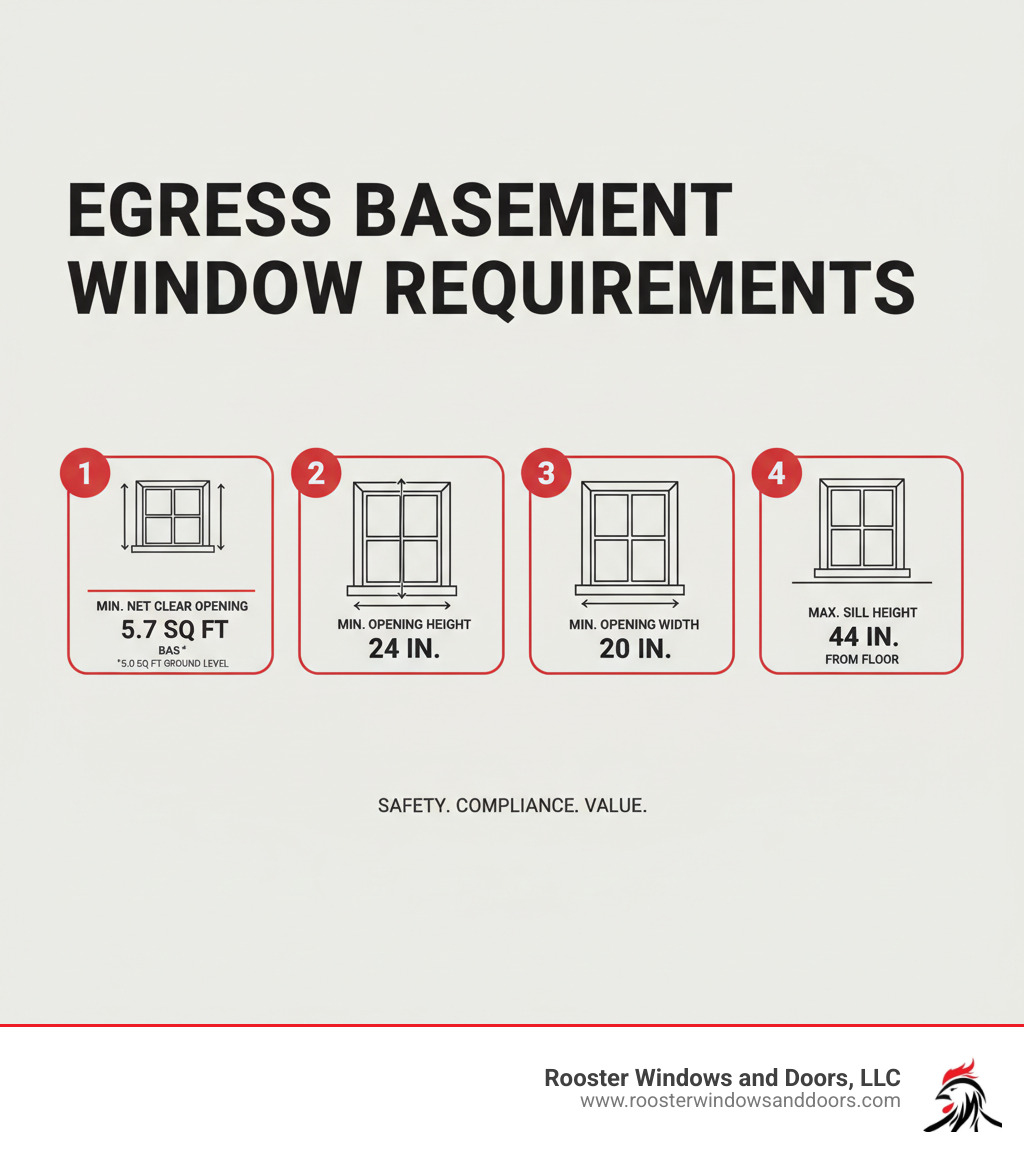
Key Egress Window Requirements:
- Minimum Net Clear Opening: 5.7 square feet for basements (5.0 sq ft for ground level)
- Minimum Opening Height: 24 inches
- Minimum Opening Width: 20 inches
- Maximum Sill Height: 44 inches from the finished floor
Beyond safety, an egress window transforms a dark basement by adding natural light and fresh air, eliminating the common “dungeon feeling.” The International Residential Code (IRC) mandates at least one egress window in every habitable basement room. Without one, you cannot legally use the space as a bedroom, and non-compliance can lead to fines and serious liability.
Installing a code-compliant egress window can also increase your property value by $10,000-$20,000 by creating legal living space. As an installer with Rooster Windows and Doors for over two decades in the Chicagoland area, I’ve seen how these windows make homes safer and more valuable. Understanding the requirements is the first step toward achieving this.
Learn more about egress basement window:
What is an Egress Window and Why is it Crucial for Basements?
An egress basement window is an emergency exit designed to save lives. When fire or smoke blocks your stairs, it provides a reliable escape route for your family and an entry point for firefighters with their equipment. Building codes are strict about their size and placement for this reason—it’s a matter of life and death.
Beyond safety, egress windows solve the “dungeon feeling” common in basements. By flooding the space with natural light and fresh air, they transform a dark cave into a bright, inviting living area. If you plan to finish your basement or add a bedroom, an egress window is a legal requirement to classify the space as habitable.
For a deeper dive into changing your basement with the right windows, check out our comprehensive guide on Basement Windows.
The Key Differences Between Egress and Standard Basement Windows
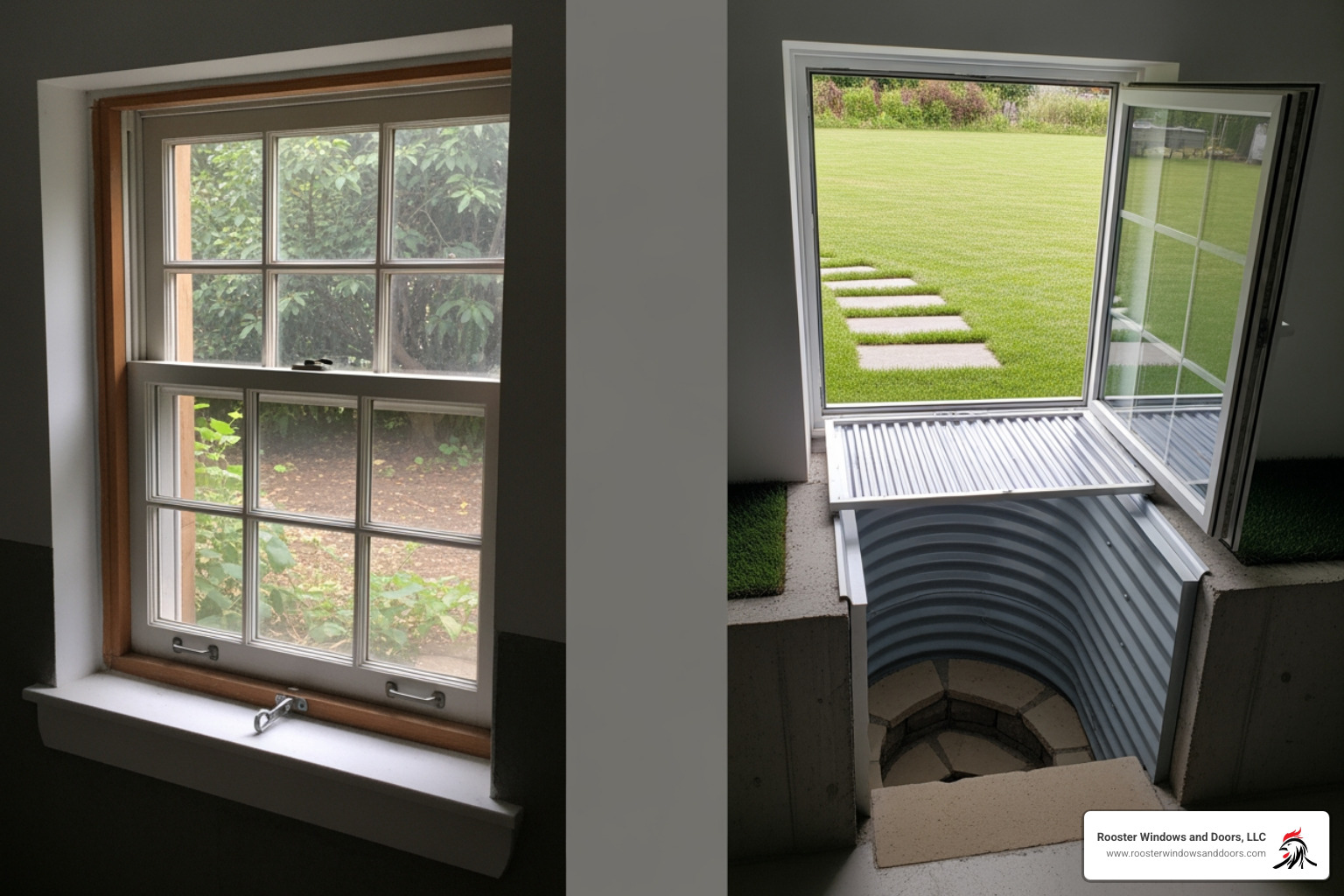
Your existing small basement window likely doesn’t qualify as an egress window. Standard hopper or slider windows in older homes are too small for escape. The key differences are size, function, and operability.
An egress window must have a net clear opening of at least 5.7 square feet—the actual space you can climb through. This is large enough for a firefighter in full gear. It must also open easily from the inside without keys or special tools. In a panic, you need an exit that operates instantly. Standard windows are often too small, stuck, or difficult to open, making them unsuitable for emergencies.
The Importance of Egress for Habitable Spaces
If you’re creating a basement bedroom, home office, or guest suite, an egress basement window is mandated by law. Section R310.1 of the International Residential Code (IRC) requires an emergency escape opening in every sleeping room and habitable basement. Without one, a finished room is legally just “storage space,” not a bedroom.
Financially, installing an egress window is a smart investment. Adding a legal bedroom can increase your property value by $10,000 to $20,000 or more in the Chicagoland area. You’re not just cutting a hole in your foundation; you’re creating legitimate, valuable living space that makes your home safer and more marketable.
Decoding Egress Window Building Codes: Size, Height, and Placement
Understanding building codes for egress basement windows is essential for safety and legal compliance. The International Residential Code (IRC) sets the national standard, but local authorities in Chicagoland communities like Naperville, Evanston, or Aurora may have specific additional requirements. This is why pulling the correct permits and working with your local building department is non-negotiable.
Ignoring codes can lead to fines, problems when selling your home, and liability in an emergency. While old, untouched windows may be “grandfathered in,” any renovation or conversion of a basement to a habitable space requires you to meet current codes. These rules exist to save lives.
For a deeper dive into the installation process, check out our Egress Window Installation guide.
Specific IRC Requirements for Egress Windows
The IRC and International Building Code outline specific dimensions that are law, not suggestions. These ensure a person can escape and a firefighter can enter.
- Minimum Net Clear Opening: This is the actual open space you can climb through. For basements, it must be at least 5.7 square feet. For ground-floor windows, the requirement is 5.0 square feet.
- Minimum Opening Dimensions: The opening must be at least 24 inches high and 20 inches wide.
- Maximum Sill Height: The bottom of the window opening cannot be more than 44 inches from the finished floor. If it is, a permanent ladder or steps must be installed in the window well.
As stated in Section R310.1 of the International Residential Code (IRC), these openings are required in every sleeping room and in basements with habitable space.
How to Ensure Your Installation is Compliant
Achieving a compliant egress basement window installation requires a methodical approach. Start by verifying your local codes, as municipalities across Illinois can have unique amendments. A professional consultation is invaluable here. At Rooster Windows and Doors, we have experience with the permit process in dozens of Chicagoland communities and understand the local nuances.
The installation involves complex structural work, including cutting concrete and ensuring proper waterproofing. This is why working with experienced installers is critical. We handle the entire permit process, from submitting plans to scheduling final inspections. The final sign-off from a local inspector confirms your basement meets all safety codes, protecting you legally, adding value to your home, and providing peace of mind.
Learn more about finding qualified professionals in our Egress Window Installers Best Guide.
Types of Egress Windows and Their Pros and Cons
Choosing the right egress basement window involves balancing safety, function, and aesthetics. The three main styles are casement, sliding, and hung windows. Modern egress windows are typically made from durable, low-maintenance vinyl or fiberglass. For the Illinois climate, look for energy-efficient options like insulated Low-E glass with argon gas fills to keep your basement comfortable and reduce energy bills.
Casement, Sliding, and Hung Windows
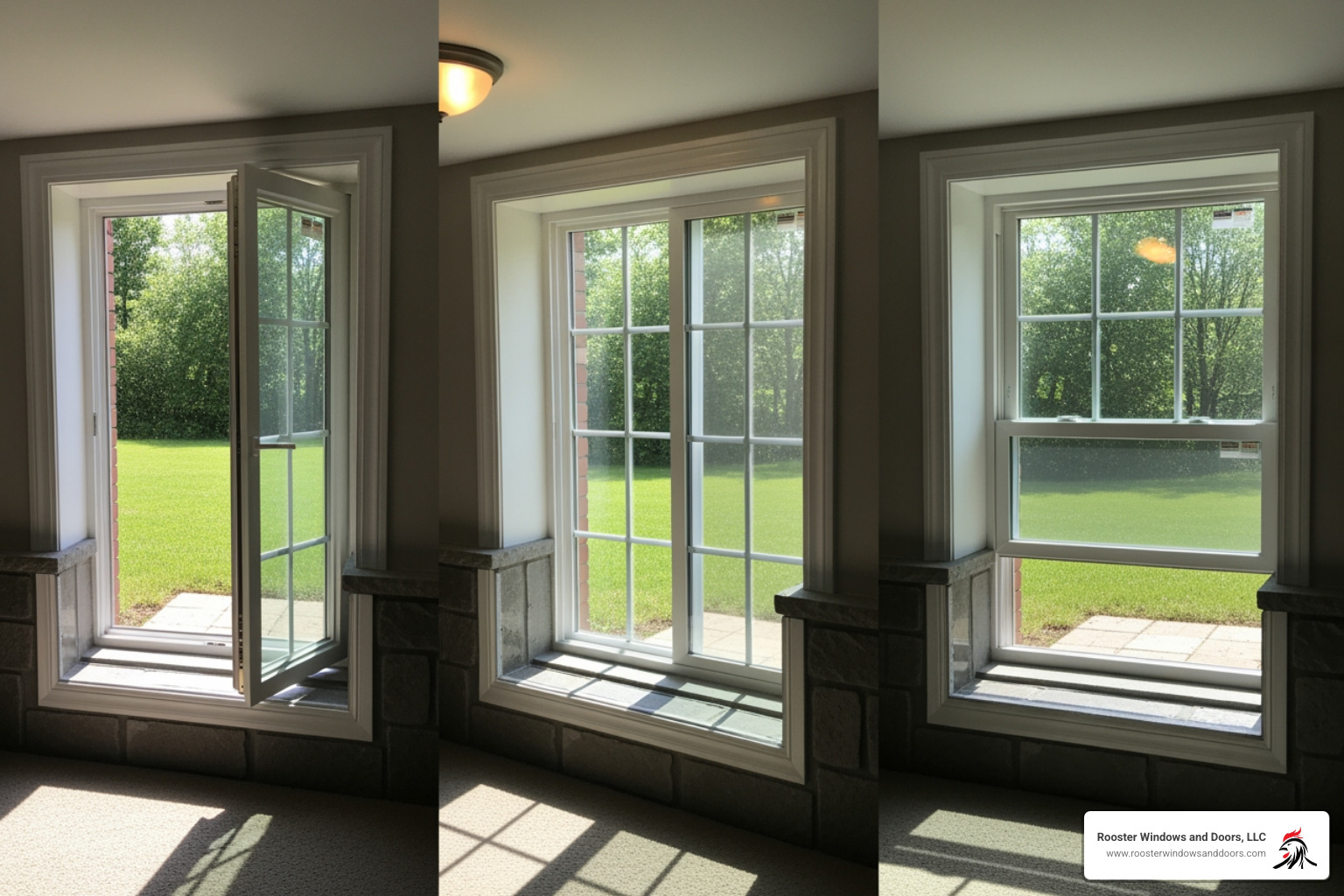
Casement windows are often ideal for egress. They swing open like a door with a crank, providing a large clear opening even with a smaller frame. Their ease of operation is a major safety benefit. In-swing casements are a practical option for basements, as they open into the room, avoiding obstruction in the window well. Egress casements typically measure 28-36 inches wide and 35.5-48 inches tall.
Sliding windows feature one sash that glides horizontally past the other. They offer a modern look but require a wider overall window to achieve the 5.7 square foot opening, since only half of the window opens. Egress sliders usually range from 47.5-60 inches wide and 35.5-60 inches tall.
Single-hung and double-hung windows operate vertically. Because the sashes slide past each other, they require a much taller opening to meet the minimum 24-inch clear height. This often makes them the largest and most challenging option for basement egress. Egress double-hung windows can be 28-60 inches wide and 23.5-60 inches high.
| Window Type | Net Clear Opening | Ease of Operation | Space Requirements |
|---|---|---|---|
| Casement | Excellent – often achieve 5.7 sq ft with smaller overall frame | Very easy – crank opens the sash fully, like a door | Requires exterior clearance for the sash to swing out; can be in-swing for egress. |
| Sliding | Good – one sash slides past the other | Moderate – requires pushing the sash horizontally | Requires wider wall opening; one side remains fixed. |
| Double-Hung | Moderate – both sashes can move vertically | Moderate – requires lifting sashes vertically | Requires taller wall opening; both sashes move but don’t fully clear the opening. |
Maintenance and Energy Efficiency for Your Egress Basement Window
Modern egress basement windows are designed for easy maintenance. Many feature tilt-in or removable sashes for convenient cleaning from inside. Regular cleaning of the glass and tracks ensures smooth operation, which is critical in an emergency. Also, periodically check the weatherstripping for a tight seal against drafts and moisture.
Proper installation with professional flashing and sealing is the first line of defense against water. For energy efficiency, choose windows with an Energy Star rating. These units feature insulated double or triple-pane glass with Low-E coatings and argon gas fills, which reflect heat and provide superior insulation. This is a smart investment that lowers heating and cooling costs in the demanding Chicagoland climate. For added insulation and safety, consider a window well cover, as explained in our guide on Covers for Basement Windows.
Installation Essentials for Your Egress Basement Window
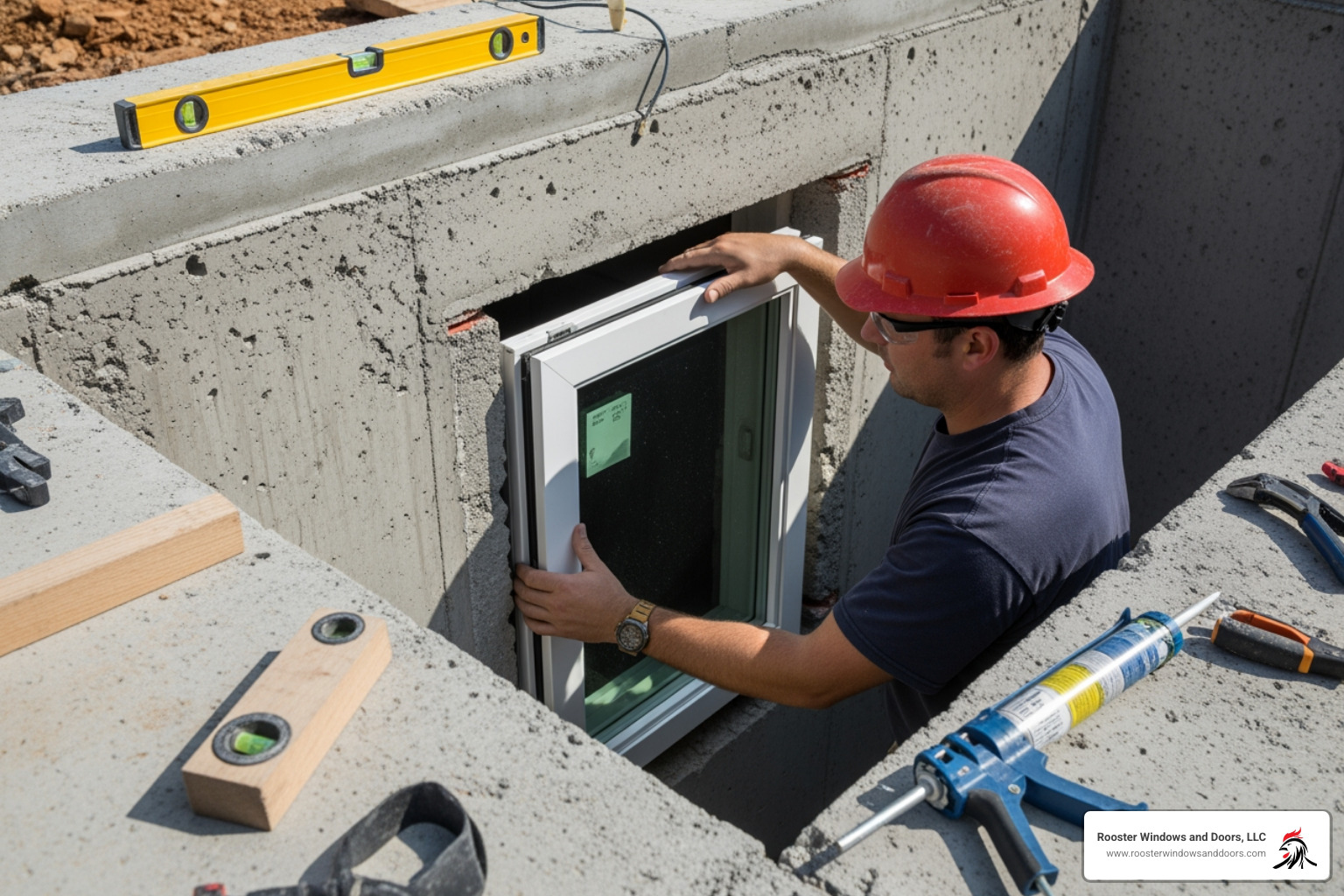
Installing an egress basement window is a major structural project, not a simple replacement. In Chicagoland, this often means cutting through solid concrete foundations, which requires specialized equipment and expertise to maintain your home’s structural integrity.
The process involves several critical steps:
- Concrete Cutting: Creating the opening with diamond-tipped saws while managing dust and debris.
- Foundation Work: Reinforcing the new opening with a steel or wood header to redistribute the structural load.
- Waterproofing and Flashing: Applying multiple layers of protection to direct water away from the opening and prevent leaks.
- Drainage: Ensuring the window well has proper grading and gravel to prevent water from pooling against the window.
Skipping or improperly performing any of these steps can lead to catastrophic structural failure or chronic water issues.
Window Wells: A Necessary Component
If your egress window is below ground level, a window well is mandatory. It provides the necessary space to escape. Codes require the well to project at least 36 inches from the foundation and be wide enough for a person to exit. If the well is deeper than 44 inches, a permanently attached ladder or steps are required. A quality window well cover is also highly recommended to keep out debris and prevent falls, while still being easy to open from inside. Proper drainage within the well, often tied to your home’s drain tile or sump pump, is essential to prevent it from filling with water. Our Window Well Companies Near Me guide can help you understand your options.
Understanding the Costs of an Egress Basement Window Installation
In the Chicagoland area, a complete egress basement window installation typically costs between $4,000 and $10,000. Key factors influencing the price include the window type, excavation difficulty, structural work required, window well material, labor, and permit fees. While this is a significant investment, the return is substantial. Adding a legal bedroom can increase your property value by $10,000 to $20,000, often covering the cost of the project while adding priceless safety. For a detailed breakdown, see our guide on Egress Window Installation Cost.
The Value of a Professional Installation
Given the complexity, a professional installation is the only safe choice for an egress basement window. The project involves structural engineering, waterproofing, and strict code compliance. DIY attempts or work by inexperienced contractors can lead to water leaks, failed inspections, or even foundation damage. At Rooster Windows and Doors, our two decades of experience ensure a safe, code-compliant installation that performs for decades. We handle the entire process, from permits to final inspection, guaranteeing your new living space is legal, valuable, and secure. Learn more at our Window Installation Services page.
Frequently Asked Questions about Egress Basement Windows
Here are answers to the most common questions we hear from Chicagoland homeowners about egress basement windows.
How many egress windows are required in a basement?
The International Residential Code (IRC) requires at least one egress opening in every habitable room in a basement. This is mandatory for any room used as a bedroom. An open-concept basement may only need one, but a layout with two separate bedrooms would require two egress windows—one in each bedroom. Always check with your local building department, as requirements can vary slightly between municipalities.
Can I install an egress window myself?
We strongly advise against it. Installing an egress basement window is a complex project with serious risks. It involves cutting your home’s foundation, which can compromise its structural integrity if done incorrectly. The process requires specialized tools, knowledge of waterproofing techniques, and a thorough understanding of local building codes. Failed DIY projects often lead to costly repairs, failed inspections, and water damage. For safety and guaranteed compliance, this job is best left to experienced professionals. Our guide on How to Install New Basement Window illustrates the complexity involved.
What happens if I don’t have a compliant egress window?
Non-compliance has severe consequences. Legally, you face fines and significant liability in an emergency. Financially, you cannot list the space as a bedroom when selling your home, which can reduce your property value by $10,000 to $20,000. Most importantly, you are putting your family’s lives at risk. In a fire, a non-compliant window can trap occupants in the basement with no safe way out. It is a life-safety issue that should never be ignored.
Conclusion
An egress basement window is a powerful investment in your home, delivering safety, value, and livability. It provides a code-required emergency exit, transforms a dark basement with natural light, and adds significant worth by creating legal, habitable space. While the installation is a complex job involving concrete cutting, structural work, and waterproofing, the benefits are undeniable.
A professionally installed egress window offers peace of mind, knowing your family is protected. It also offers a financial return, often increasing property value by $10,000 to $20,000.
At Rooster Windows and Doors, we have spent over two decades providing Chicagoland homeowners with high-quality, flawless, and energy-efficient egress window installations. We manage every detail, from navigating local codes in communities across Cook, Lake, and DuPage counties to the final inspection. We ensure your project is code-compliant and built to last.
Don’t wait to make your basement safer and more valuable. Explore your basement window options today and let Rooster Windows and Doors help you create the bright, safe, and inviting basement your home deserves.
