

Beyond the Basement: The Truth About Egress Windows and Home Square Footage
Why Egress Window Square Footage Matters for Every Homeowner
Egress window square footage is more than just a building code requirement—it’s about creating safe, legal living spaces in your home. Whether you’re finishing a basement, adding a bedroom, or renovating an older property, understanding the precise square footage requirements can mean the difference between a compliant escape route and a failed inspection.
Quick Answer: Minimum Egress Window Square Footage Requirements
| Code | Minimum Area | Minimum Width | Minimum Height | Maximum Sill Height |
|---|---|---|---|---|
| US (IRC) | 5.7 sq ft (5.0 sq ft at grade) | 20 inches | 24 inches | 44 inches |
| Canada (NBC) | 3.77 sq ft (0.35 m²) | 15 inches | 15 inches | 59 inches (1.5 m) |
The confusion starts when homeowners assume the glass size equals the egress opening. It doesn’t. A window advertised as 36″ × 48″ might only provide 4.8 square feet of actual escape space once you account for the frame, sash, and hardware—failing the 5.7 square foot minimum required by the International Residential Code (IRC).
This matters because any room used for sleeping must have a compliant egress window or exterior door. Without it, that “bedroom” isn’t legally a bedroom, which affects home valuations, insurance coverage, and most importantly, life safety during emergencies like fires.
More than half of Canadian homes have basement bedrooms, and countless US homes have converted lower levels into living spaces. Yet many of these rooms contain windows that look large enough but fall short when measured properly. A 15″ × 15″ opening might meet minimum dimension requirements but delivers only 1.56 square feet—nowhere near the 3.77 square feet minimum in Canada or 5.7 in the US.
As Piotr Wilk with over two decades installing windows across the Chicagoland area, I’ve seen countless homeowners surprised when their basement “bedroom” fails inspection due to improper egress window square footage. Through thousands of installations in Lake, Cook, and McHenry Counties, I’ve learned that getting this right the first time saves money, stress, and ensures your family’s safety.
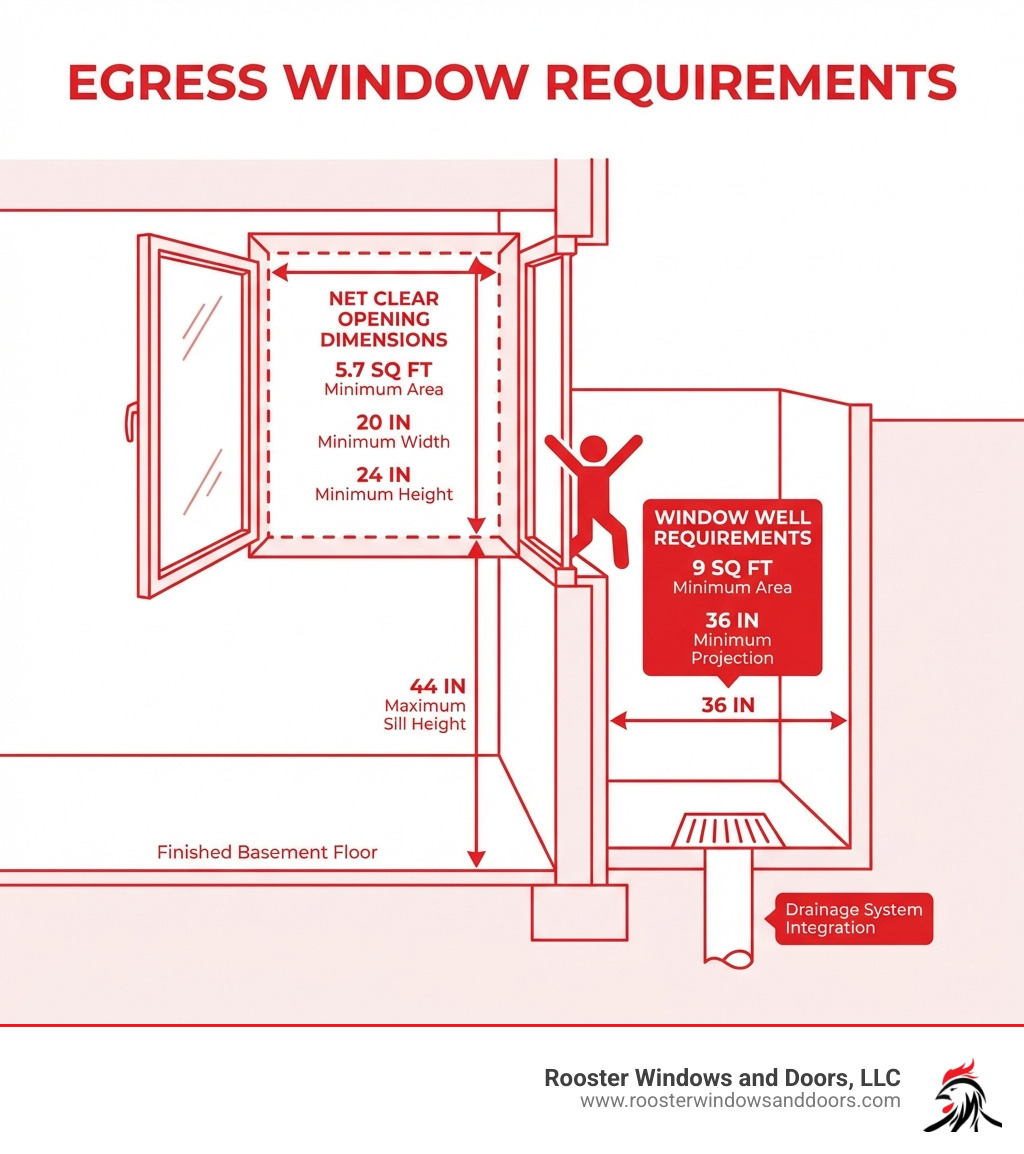
Egress window square footage terms to know:
Understanding Egress Window Square Footage Requirements
When we talk about egress window square footage, we are specifically referring to the “net clear opening.” This is the actual space you can crawl through when the window is fully opened. The International Residential Code (IRC) is the standard most municipalities in Illinois follow. It mandates that every sleeping room, basement with habitable space, and attic with habitable space must have at least one “Emergency Escape and Rescue Opening” (EERO).
The magic number for most US homes is 5.7 square feet. However, there is a notable “grade-floor exception.” If the window is at the ground level (grade level), where the sill is no more than 44 inches above the exterior ground, the requirement drops slightly to 5.0 square feet. This is because it is generally easier for a firefighter to climb into a ground-floor window than one that requires a ladder.
| Metric | US (IRC 2021) Standard | Canadian (NBC) Standard |
|---|---|---|
| Min. Net Clear Area | 5.7 sq. ft. (5.0 sq. ft. at grade) | 3.77 sq. ft. (0.35 m²) |
| Min. Opening Width | 20 inches | 15 inches (380 mm) |
| Min. Opening Height | 24 inches | 15 inches (380 mm) |
| Max. Sill Height | 44 inches from floor | 59 inches (1.5 m) from floor |
It is important to note that meeting the minimum width and height simultaneously does not necessarily mean you meet the area requirement. For example, a window that is 20″ wide and 24″ high only provides 3.33 square feet of opening. To hit the 5.7 mark, one of those dimensions must be significantly larger. For egress window installation in Chicagoland, we often recommend windows that are at least 28″ x 46″ to ensure they comfortably pass inspection.
Calculating Egress Window Square Footage for US Homes
To calculate the egress window square footage, use this simple formula: Width (inches) × Height (inches) ÷ 144 = Square Footage
You must use the net clear dimensions. If you have a sliding window, you only measure the space created when the sash is pushed all the way to the side. Under the International Building Code (IBC), which typically applies to larger multi-family residential buildings, the requirements are very similar to the IRC, emphasizing that the window must be operable from the inside without the use of keys, tools, or special knowledge.
Canadian National Building Code (NBC) Standards
While our primary focus is the Illinois market, many of our clients ask about Canadian standards for secondary properties. The National Building Code of Canada (NBC) requires a minimum unobstructed opening of 0.35 square meters (3.77 square feet). Additionally, no dimension (height or width) can be less than 15 inches (380 mm).
Just like in the US, a 15″ x 15″ window fails the area test in Canada because it only provides 1.56 square feet. To meet the 3.77 sq. ft. requirement, a 15-inch-wide window would need to be at least 36.2 inches tall.
Measuring Net Clear Opening vs. Nominal Size
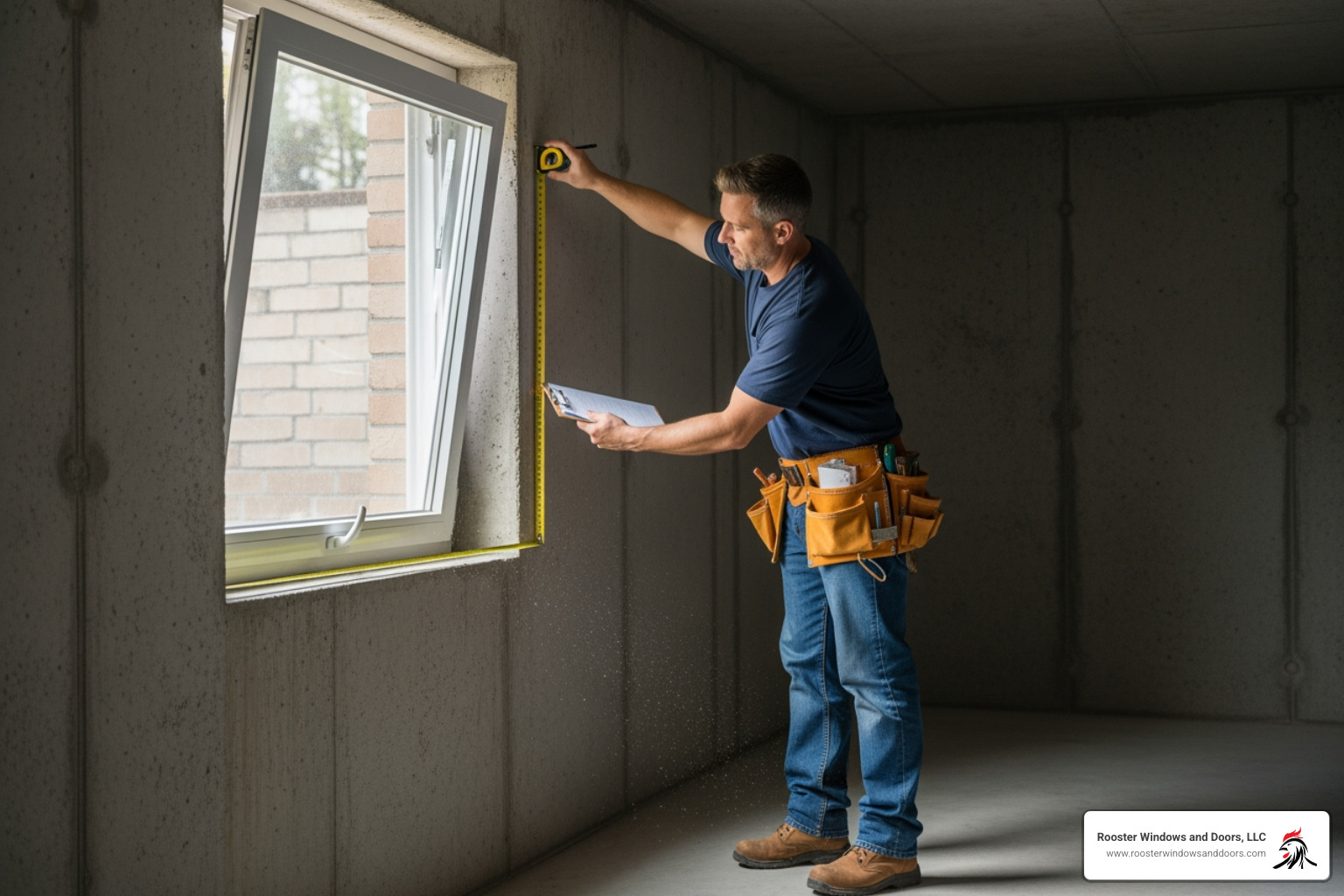
One of the biggest mistakes we see in DIY projects is confusing the nominal size with the net clear opening. The nominal size is what you see on the sticker at the hardware store (e.g., 36″ x 48″). This represents the rough opening or the outer frame dimensions.
The net clear opening is the actual hole left when the window is open. You have to subtract:
- The thickness of the window frame.
- The thickness of the sash.
- Any hardware that protrudes into the space, like crank handles or locks.
For a detailed walkthrough on how to avoid these measurement traps, check out our egress window installation complete guide.
Common Pitfalls in Egress Window Square Footage Measurements
In our years of service in places like Naperville, Aurora, and Elgin, we’ve encountered several recurring measurement errors:
- The “Double-Hung” Trap: In a double-hung window, the sashes overlap. You only get half the window’s total height as an opening. Many homeowners measure the whole window and assume it qualifies.
- Crank Handles: On some casement windows, the crank handle or the hinges might restrict how far the window opens, eating into your 20-inch width requirement.
- Meeting Rails: The horizontal bar in the middle of a window can block the “clear” path, meaning only the space above or below it counts.
Working with an egress window installers best guide can help you identify these issues before you cut into your foundation.
Basement Egress: Window Wells and Safety Standards
If your egress window square footage is located below ground level—which is common in Chicagoland basements—you must install a window well. The well itself has its own set of “square footage” rules.
According to the IRC, a window well must provide a minimum horizontal area of 9 square feet. It must also have a minimum horizontal projection and width of 36 inches. This ensures that an adult, possibly wearing bulky firefighting gear, has enough room to climb out and away from the building.
If the window well is deeper than 44 inches, a permanent ladder or steps must be installed. The ladder cannot encroach more than 6 inches into the required 36-inch projection of the well. For more on the specific products we use, visit our page on basement window solutions or search for window well companies near me to see why our installations stand the test of time.
Structural and Drainage Considerations
Installing an egress window in a basement isn’t just about the window; it’s a major structural project. We often have to perform “foundation cutting” to enlarge the opening. This requires the installation of a lintel (a horizontal structural beam) to support the weight of the wall above the new, larger window.
Drainage is equally critical. Without a proper drainage system, your new window well becomes a giant bucket for rainwater, leading to basement flooding. We typically install a drainage pipe that connects to the home’s interior or exterior perimeter drain (drain tile) and use a gravel bed to facilitate water flow. For a deep dive into the technical side, read how to install new basement window.
Choosing the Right Window Type for Compliance
Not all windows are created equal when it comes to meeting egress window square footage requirements. Here is a breakdown of the most common types:
- Casement Windows: These are the gold standard for egress. Because they swing open like a door, almost the entire window area counts toward the net clear opening.
- Sliding Windows: To meet egress with a slider, the window usually has to be quite large (at least 4 feet wide) because only half of the window opens at a time.
- Double-Hung Windows: These are often the hardest to make compliant. To get a 24-inch clear opening height, the window itself often needs to be nearly 5 feet tall.
- Awning Windows: These are generally not suitable for egress because the glass sash stays in the way of an escape path, and the opening mechanisms are often too restrictive.
Because of the complexity of these choices, egress window installation cost can vary significantly based on the window style you choose.
Why Casement Windows Win for Egress Window Square Footage
We almost always recommend casement windows for egress retrofits in the Chicagoland area. Why?
- Maximum Efficiency: You get the most “net clear opening” for the smallest “rough opening.” This means we don’t have to cut as much of your foundation.
- Ease of Use: Most modern casements feature “egress hinges” that slide the sash away from the frame as it opens, maximizing the width.
- Ventilation: They offer superior airflow compared to sliders or hung windows.
Our basement windows complete guide provides more details on why casements are the favorite of inspectors and homeowners alike.
Frequently Asked Questions about Egress Windows
Can I install security bars or grilles on egress windows?
Yes, you can, but there are strict rules. According to International Residential Code (IRC) Section R310.4, any security bars, grilles, or covers must be releasable from the inside without the use of a key, tool, or even special knowledge. The release mechanism must be intuitive—if you’re in a dark, smoke-filled room, you should be able to pop the bars off instantly.
What is the maximum sill height allowed for egress?
The maximum sill height is 44 inches from the finished floor. If your window is higher than this (common in older basements), you are required to provide a permanent step or ladder to reach the window. This step must be permanently affixed to the wall or floor. If you are looking for ways to protect these openings from the outside, check our guide on covers for basement windows.
Are older homes grandfathered into old egress codes?
This is a common point of confusion. If your home was built in 1950 and has tiny “coal chute” windows, you aren’t usually forced to upgrade them unless you start a renovation. As soon as you pull a permit to “finish” a basement or add a bedroom, the current code kicks in. Furthermore, if you plan to rent out a room, most local ordinances in Illinois (from Joliet to Waukegan) will require the room to meet modern egress standards for the safety of the tenant.
Conclusion
Navigating egress window square footage requirements can feel like a math exam you didn’t study for, but it is the most critical part of any basement or bedroom renovation. At Rooster Windows and Doors, LLC, we take the guesswork out of the process. From ensuring your net clear opening is exactly 5.7 square feet to installing energy-efficient glazing that keeps your Illinois home warm in the winter, we provide flawless execution every time.
We serve homeowners throughout the Chicagoland area—including Libertyville, Arlington Heights, Schaumburg, and beyond. We don’t just install windows; we provide peace of mind that your home is safe, legal, and built to last.
Ready to make your basement bedroom legal and safe? Contact us today for a professional egress window installation consultation. Let’s get your project started the right way!
