

The Smart Homeowner’s Guide to Pocket Doors
A pocket door is a sliding door that disappears completely into a hidden compartment inside the wall when open — freeing up floor space that a traditional swinging door would otherwise claim.
Quick answers at a glance:
- What it is: A door that slides into the wall instead of swinging open
- Key benefit: Saves an average of 10 square feet of usable floor space
- Best uses: Bathrooms, closets, home offices, laundry rooms
- Main types: Single panel, double (converging), glass-insert, solid core MDF
- Common cost range: ~$378 to $678+ for a complete door, frame, and hardware kit
- Biggest drawback: Hardware is hidden inside the wall, making repairs more involved
Pocket doors have been around since Victorian times, but they’re seeing a strong resurgence — and it’s easy to see why. As homes get smaller and open-concept layouts get more popular, every square foot counts. Building expert Tim Carter has called the pocket door “one of the top ten most overlooked items when many architects and builders plan a home” — and after reading this guide, you’ll understand exactly why.
This guide covers everything you need to know before buying or installing one: frame types, materials, sizing, hardware, costs, and the real challenges involved.
I’m Piotr Wilk from Rooster Windows and Doors, LLC, and over more than two decades of residential door installation across the Chicagoland area, my team and I have helped countless homeowners choose and install the right pocket door for their space. In the sections below, I’ll walk you through everything we’ve learned so you can make a confident, informed decision.
Understanding the Pocket Door: Definition and Key Benefits
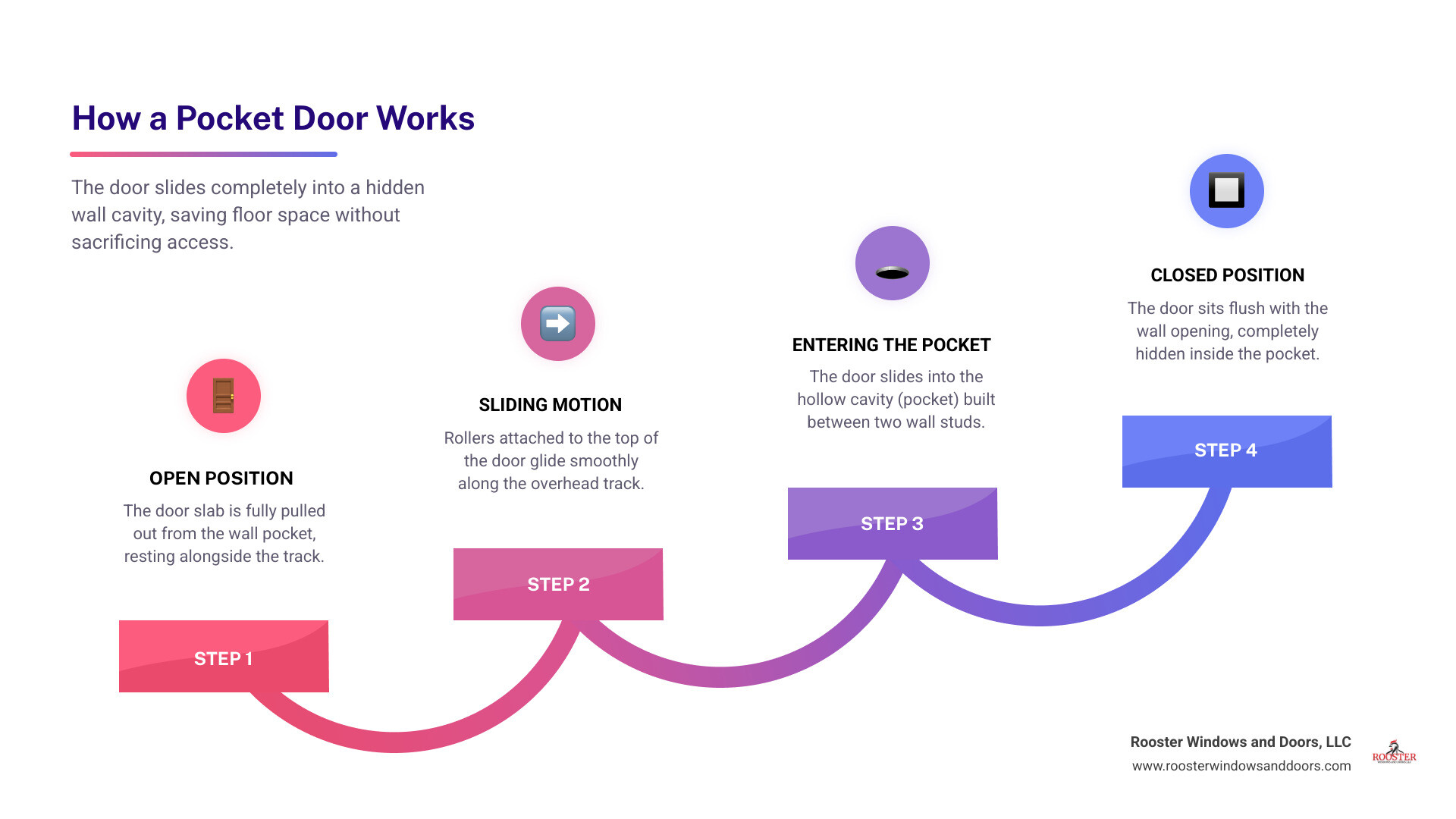
At its core, a pocket door is a sliding door system suspended from an overhead track. Instead of swinging on hinges, the door slab travels along this track and glides directly into a recess (or “pocket”) built inside the wall.
The single greatest benefit of this design is dramatic space savings. Replacing a traditional swinging door with a pocket door can free up an average of ten square feet (0.93 m²) of floor space. In smaller rooms, that extra space can be the difference between fitting a double vanity in a bathroom or having to settle for a single sink.
Beyond space efficiency, these doors offer incredible design flexibility. They allow you to create temporary room dividers or close off spaces when privacy is needed, without permanently cluttering your sightlines. To learn more about how this fits into your broader home renovation plans, check out our Interior Door Replacement Complete Guide.
Pocket Door vs. Traditional Hinged Doors
Traditional hinged doors require a wide “swing path” to open and close. This means you cannot place furniture, decor, or fixtures within that radius. A pocket door eliminates the swing path entirely, keeping the door slab securely contained within the wall cavity.
However, they do require a completely clear wall cavity free of electrical wiring, plumbing, and structural studs.
| Feature | Pocket Door | Traditional Hinged Door |
|---|---|---|
| Floor Space Saved | Average of 10 sq. ft. | 0 sq. ft. (Requires swing clearance) |
| Wall Space Required | Double the door width (internal pocket) | Minimal (only the frame width) |
| Aesthetics | Clean, minimalist, disappears when open | Visible slab, classic traditional look |
| Installation Complexity | High (requires wall cavity modification) | Low to Moderate |
| Sound Insulation | Moderate (varies by core material) | High (tight seal against jambs) |
Best Applications for Space-Saving Doors
Because pocket doors maximize floor space, they are incredibly popular in tight residential layouts. The most common applications we install in the Chicagoland area include:
- Bathrooms and Powder Rooms: Where toilet or vanity placement makes a swinging door awkward.
- Walk-in Closets and Pantries: Allowing you to utilize the adjacent wall space for shelving or dressing areas.
- Home Offices: To close off a workspace for video calls without cluttering the hallway.
- Laundry Rooms: Keeping loud washing machines hidden away when not in use.
If you are looking to maximize space in other parts of your home, you might also want to read our guides on Sliding Closet Door Installation or how to Install Folding Closet Doors.
Frame Types, Wall Thickness, and Hardware Options
Choosing the right pocket door frame is the most critical step of the project. If you select a flimsy frame, your wall can bow, causing the door to scrape or get stuck.
Standard pocket door frames are engineered specifically for either 2×4 walls or 2×6 walls:
- 2×4 Stud Walls: Standard frames for 2×4 walls typically accommodate doors that are 1-3/8 inches thick.
- 2×6 Stud Walls: If you have thicker 2×6 framing, you can install a heavier, thicker door (up to 1-3/4 inches) for improved structural stability and sound dampening.

When it comes to frame durability, we highly recommend heavy-duty, steel-reinforced systems. For example, standard unassembled pocket door frames with a 150 lb capacity (adjustable up to 3’0″ x 6’8″) have a list price of around $272.00. If you are hanging a heavier solid wood or glass door, upgrading to a 250 lb capacity unassembled frame (adjustable up to 4’0″ x 8’0″) will cost about $406.00.
For premium installations, specialized heavy-duty frame series offer exceptional rigidity:
- 3500-150 Series (2×4 walls, 1-3/8″ thick doors): Starts at $533.00 for an 80″ or 84″ door, up to $541.00 for a 96″ door.
- 3500-325 Series (2×4 walls, heavy-duty): Starts at $936.00 (80″ or 84″ door) up to $977.00 (96″ door).
- 5500-150 Series (2×6 walls): Starts at $558.00 (80″ or 84″ door) up to $563.00 (96″ door).
- 5500-325 Series (2×6 walls, heavy-duty): Starts at $1,075.00 (80″ or 84″ door) up to $1,117.00 (96″ door).
Choosing the Right Pocket Door Size and Rough Opening
To ensure your door operates smoothly, you must calculate the rough opening dimensions precisely. The golden rule for pocket door framing is:
- Rough Opening Width: Twice the width of the door slab plus 1 inch.
- Rough Opening Height: The height of the door slab plus 4.5 inches.
For example, if you are installing a standard 30 in. x 80 in. door, your rough opening must be 61 inches wide and 84.5 inches high.
If you are replacing an existing door, make sure to check out our guides on Replacing Interior Doors and Replacing Interior Door Frame to understand how these dimensions impact your surrounding drywall.
Soft-Close and Automatic Systems
Modern hardware has completely transformed the pocket door experience. Gone are the days of noisy, rattling tracks and slammed fingers.
High-quality kits, such as the 30 in. x 80 in. 5 Lite Glass White Primed MDF Pocket Sliding Door with Pocket Door Hardware Kit (Soft Close Included) (priced at $448.00), feature integrated soft-close mechanisms. These systems catch the door as it nears the end of its track, gently pulling it fully open or closed.
If you are planning a double-door entryway, you can utilize a synchronized system. A synchronized frame, like the heavy-duty 3500-SYNCHRO Series (starting at $1,299.00 for 2×4 walls), connects two converging doors so that opening or closing one door automatically moves the other.
Materials, Applications, and Installation Challenges
The material you choose for your door slab affects not only how it looks but how it performs over time.

Material Selection and Soundproofing
Standard hollow-core doors are lightweight, but they offer virtually no soundproofing. For privacy, we recommend solid-core materials:
- Solid Core MDF: Medium-Density Fiberboard is highly stable and does not warp with humidity. It is also incredibly effective at blocking noise—providing up to 70% more sound dampening than hollow-core alternatives. The Jujubon Panel Pocket Door with Hardware Kit & Frame, Solid Core Wood, White ($385.00) is a fantastic, scratch-resistant MDF option that can even be trimmed up to 0.5 inches on the top or bottom for custom fits.
- Solid Wood: Classic and heavy, but susceptible to moisture. If you choose an unfinished wood door, it must be painted or sealed within one week of receipt to prevent warping.
- Glass Inserts: Perfect for allowing natural light to flow between rooms. A Sliding Pocket Wood Door with Frosted Glass Insert or a multi-lite option like the 30 in. x 80 in. 10-Lite Clear Glass White Primed MDF Pocket Sliding Door with Pocket Door Frame and Hardware Kit ($378.00) uses tempered safety glass to balance elegance and privacy.
Cost Comparison: Sliding vs. Traditional Doors
While standard swinging doors are generally cheaper upfront, pocket doors offer unparalleled long-term space utility.
- Basic Single Kits: A complete single pocket door kit with an MDF slab, frame, and hardware ranges from $378.00 to $448.00.
- Large Double Door Kits: Larger systems, like the 48 in. x 80 in. Paneled White Primed MDF Pocket Sliding Door with Pocket Door Frame and Hardware Kit ($677.99), are ideal for wide room dividers.
- Installation Costs: Installing a pocket door is more labor-intensive than hanging a standard door because it requires framing, drywall work, and trim. If you are retrofitting an old home, check out our guide on Replacing Interior Doors in Old House to budget for these unique structural needs.
Common Challenges and Downsides
Before committing to a pocket door, it is important to understand the potential downsides:
- Hidden Hardware: Because the track and rollers are tucked inside the wall, making repairs can be difficult. If a roller jumps off the track or breaks, you may need to remove trim or cut into your drywall.
- Wall Limitations: The wall containing the pocket cannot have electrical outlets, switches, plumbing pipes, or heavy wall anchors (like those used for wall-mounted TVs) on that specific section.
- Warping Risks: Cheap wood doors can warp over time due to seasonal humidity, causing them to rub against the internal studs.
To prevent these issues, always invest in a high-quality, rigid frame and heavy-duty hardware during the initial installation. For troubleshooting tips, read our Pocket Door Repair Complete Guide.
Frequently Asked Questions about Sliding Doors
Can I install a sliding door in an existing wall?
Yes, but it requires retrofitting. You will need to remove the drywall on one side of the wall, remove the existing studs, install a dedicated pocket door header and frame, and then hang new drywall. This is a highly technical task that is best left to professional installers to ensure structural walls are not compromised.
What is the standard rough opening for a sliding door?
The standard rough opening width is twice the door’s width plus 1 inch. The rough opening height is the door’s height plus 4.5 inches. For a standard 30″ x 80″ door, you will need a rough opening of 61″ x 84.5″.
Are sliding doors good for soundproofing?
Historically, pocket doors had a reputation for poor soundproofing due to the gaps around the track and floor guide. However, using a solid-core MDF door slab (which is up to 70% more sound-dampening than hollow-core doors) along with quality weatherstripping or jamb seals can provide excellent acoustic privacy.
Conclusion
A pocket door is one of the smartest design upgrades you can make to your home. By reclaiming 10 square feet of floor space, it opens up a world of layout possibilities in bathrooms, closets, and home offices. However, because the system is built directly into your home’s structural framing, choosing heavy-duty materials and ensuring a flawless installation is paramount to avoid future headaches.
At Rooster Windows and Doors, LLC, we pride ourselves on providing high-quality, flawless, and energy-efficient installations tailored to your home’s unique layout. Whether you live in Libertyville, Lake Forest, Highland Park, Schaumburg, Northbrook, or anywhere else in the Chicagoland area, our expert team is here to help.
Ready to upgrade your home with beautiful, space-saving sliding doors? Explore our Door Services or schedule your professional Door Installation or Door Replacement today by visiting our Door Installation Pillar Page. Let us help you do it right the first time!

