

Your First Look at Exterior Door Trim Ideas That Actually Work
If you’re exploring exterior door trim ideas, here’s a quick overview of the most popular options to inspire your next project:
| Style | Best For | Key Feature |
|---|---|---|
| Craftsman flat stock | Bungalows, historic homes | Wide boards, extended header |
| Minimalist flat stock | Modern, contemporary homes | Clean lines, mitered corners |
| Greek Revival pediment | Traditional, colonial homes | Pilasters, dentil detail |
| Farmhouse board trim | Rustic, country-style homes | Wide planks, matte finish |
| High-contrast black and white | Any style | Bold visual impact |
| Arched casing | Stucco or brick exteriors | Softens square doors |
| Layered double flat stock | Any style needing depth | Dimensional, built-up look |
Your front door is the first thing people see. And yet, most homeowners spend hours picking the perfect door color — then completely overlook the trim that frames it.
That’s a missed opportunity.
Exterior door trim does two important jobs at once. It protects the seam between your door frame and siding from moisture, drafts, and the elements. And it defines the entire personality of your entryway — whether that’s bold and modern, warm and rustic, or classically elegant.
In the Chicagoland area, where winters are harsh and freeze-thaw cycles are relentless, choosing the right trim material and getting it installed correctly isn’t just about looks. It directly affects how well your entryway holds up year after year.
I’m Piotr Wilk of Rooster Windows and Doors, LLC — with over two decades of residential door and window installation experience across Lake, Cook, and McHenry Counties, I’ve seen how the right exterior door trim ideas can transform a home’s curb appeal and long-term performance. In this guide, I’ll walk you through the styles, materials, and installation details that actually make a difference.
What is Exterior Door Trim and Why Does It Matter?
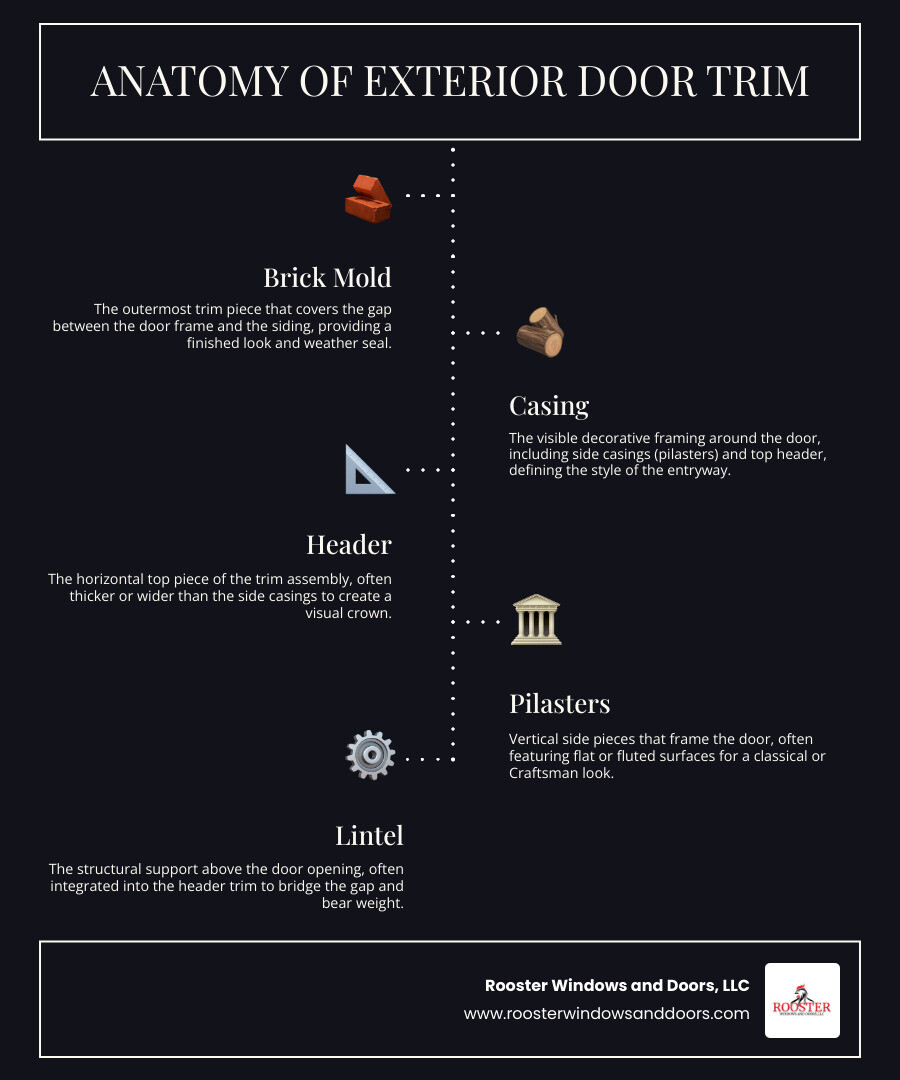
When we look at a front door, we often perceive it as a single unit. However, the architectural framing around it—technically known as the door casing—is a modular assembly of several pieces. The vertical side pieces that run along the left and right of the frame are called pilasters (or side casings), while the horizontal piece resting on top is known as the lintel or header.
In the home improvement industry, we refer to this surrounding structure as the exterior door trim. Far from being a purely decorative afterthought, this framing acts as the bridge between your home’s siding and your door system.
Framing First Impressions: Curb Appeal and Home Value
The entryway sets the tone for your entire home. High-quality door trim features precise cuts and intricate designs that align perfectly around your door, creating a seamless and elegant appearance. When properly proportioned, the trim adds visual weight and architectural character to an otherwise flat facade.
As a general rule of thumb for balanced proportions, pilasters should be roughly 1/6 of the door’s width, while the header or pediment height should be about 1/5 of the door’s total height to avoid looking top-heavy. By framing your door with these classic proportions, you instantly elevate a standard entry door into a grand architectural feature. For a treasure trove of design inspiration, you can browse through these 25 Exterior Door Trim Ideas to Elevate Your Entryway – Our Secondhand House.
Functional Protection: Weatherproofing and Sealing Seams
Beyond its aesthetic contribution, exterior trim serves a vital structural purpose. It covers the gap between your door frame and siding, shielding the underlying sheathing from water intrusion, wind, and pests. Importantly, it is designed to cover the raw edges of your siding while allowing enough breathing room for natural expansion and contraction as temperatures fluctuate.
In Northern Illinois communities like Libertyville, Lake Forest, and Highland Park, our homes experience dramatic seasonal shifts—from humid summer heat to freezing winter blizzards. Without high-quality trim and professional sealing, moisture can easily seep behind your siding, leading to rotted framing and costly drafts. To learn more about protecting your home’s envelope, check out our guide on window door weatherproofing.
Inspiring Exterior Door Trim Ideas by Architectural Style
Achieving a cohesive exterior means matching your door trim to the broader design language of your home. Whether you live in a historic Chicago bungalow, a modern townhouse in Arlington Heights, or a classic colonial in Glenview, aligning these details is key to architectural harmony.
Craftsman Exterior Door Trim Ideas for Historic Charm
The Craftsman style is defined by its emphasis on natural materials, visible handiwork, and simple, robust structural lines. If you want to replicate an authentic 1920s Craftsman look, wider and thicker boards are always superior to slim, delicate moldings.
A classic Craftsman configuration involves using 1×6 boards for the vertical side casings and a slightly larger 1×8 board for the top header. For a traditional “cap” look, the top header piece should extend about an inch past the vertical side casings on both sides. Historical Craftsman homes, such as the famous Gamble House, often utilized beaded brick mold casings that were roughly 3 1/4 inches wide, sometimes featuring side casings that tapered slightly from top to bottom.
Using modern engineered materials like LP SmartSide trim boards allows you to capture this historic charm without the maintenance headache of natural wood. For more details on sizing and historic styles, explore Exterior Door Trim: Sizes, Design Styles, Materials, and Installation.
Modern and Minimalist Exterior Door Trim Ideas
For contemporary homes in areas like Schaumburg or Evanston, less is often more. Modern design relies on clean geometry, sharp angles, and flat profiles. A crisp band of mitered flat stock is the fastest route to contemporary curb appeal.
You can choose between mitered flat stock (where the corners meet at a clean 45-degree angle) or butted flat stock (where the top header sits directly on top of the vertical side casings at a 90-degree angle). Butted flat stock offers a slightly more industrial, blocky appearance that makes the header look substantial.
Color contrast is highly effective in modern designs. Few pairings feel bolder than a jet-black slab door framed in snowy white flat-stock casing, set against flat grey exterior walls. Alternatively, you can play with a striking papaya-colored door offset by bright white pilasters to create a beautiful, high-contrast entrance. If you’re looking for more contemporary ideas, take a look at these 15 Exterior Door Trim Ideas That Will Make Your Next Entryway Look Insanely Stylish – DecorPedlar.
Traditional and Classical Pediment Styles
If your home leans toward Colonial, Georgian, or Greek Revival architecture, you can elevate your entryway with classical trim elements. This style utilizes ornamental components like a crosshead pediment (a decorative header placed over the door to add height) and fluted pilasters that mimic structural columns.
You can also integrate details like a dentil mold (a series of small, closely spaced rectangular blocks resembling teeth) or a decorative keystone centerpiece in the middle of the lintel. For homes with brick or stone facades in historic neighborhoods like Lake Zurich or Buffalo Grove, integrating white paneled pilasters with a white plinth block at the base creates a stately, timeless entrance.
If your door features sidelights or a transom window, you can use an extended casing with a fillet to surround the entire system, visually enlarging your entryway and maximizing natural light. Check out Allura’s design guide on 10 Stunning Exterior Door Trim Design Ideas | Allura USA to see how these classical elements can be combined.
Choosing the Best Materials and Sizes for Your Entryway
Choosing the right material for your exterior door trim is just as important as choosing the style. Because the trim is fully exposed to the elements, the material you select will dictate how often you need to paint, seal, and maintain your entryway.
Comparing Trim Materials: Wood, PVC, and Fiber Cement
Historically, wood was the standard for exterior trim. While natural woods like cedar offer undeniable warmth, they are soft, easily dented, and highly prone to moisture absorption, rot, and insect damage if not meticulously sealed. To solve this, advanced products like preservative-treated wood (such as Belco XT Trim) undergo specialized treatment processes using EPA-approved preservatives like Wolman AG to protect the wood fibers from within before priming.
For a completely maintenance-free lifestyle, synthetic and composite materials have become incredibly popular:
- Cellular PVC: This material cuts, routes, and nails exactly like wood, but it is completely immune to moisture, rot, warping, and termites. It holds paint for a decade or more and is highly recommended for harsh Midwest climates.
- Fiber Cement: Made from a blend of cement, sand, and cellulose fibers, fiber-cement boards resist fire, insects, swelling, and cracking. They are incredibly durable and ideal for heavy-weather zones, though they require specialized tools and priming of all field-cut edges during installation.
| Material | Pros | Cons | Best For |
|---|---|---|---|
| Preservative-Treated Wood | Authentic wood grain, structurally strong, often backed by long warranties (up to 20 years) | Requires periodic painting, can still absorb moisture if unsealed | Traditional homes, budget-friendly natural look |
| Cellular PVC | 100% rot and insect-proof, holds paint beautifully, easy to work with | Higher upfront material cost, can expand/contract in extreme heat | Low-maintenance modern upgrades, wet climates |
| Fiber Cement | Fire-resistant, termite-proof, will not warp or swell | Heavy, requires specialized cutting tools, must prime all field cuts | Wildfire-prone areas, maximum durability |
For a deeper dive into the best weather-resistant trim options, read about the Best Exterior Door Trim and Seal Options for a Fresh Look – Home Fix Hub.
Standard Sizes and Proportions for Exterior Door Trim
The standard exterior door size in builder terms is referred to as a “3068” (measuring 3 feet 0 inches wide by 6 feet 8 inches tall). When trimming out a standard 3068 door, using an 18-foot trim board allows you to cut both side legs and the header with minimal waste.
Standard trim boards typically range from 4 to 6 inches in width and 1 to 2 inches in thickness (often sold as 1×4, 1×6, or thicker 5/4 boards). If your door system has existing brick molding, you must match that depth to ensure a professional, flush finish. In these cases, using 2×4 legs paired with a 2×6 header provides the necessary depth and a clean transition to your siding.
To help plan your project finances, you can read our detailed breakdown of the cost to install door trim.
How to Install and Weatherproof Your Exterior Door Trim
Whether you plan to tackle this project yourself or hire a professional, understanding the core steps of a proper installation ensures a flawless, long-lasting finish.
Step-by-Step Exterior Door Trim Installation
To achieve professional results, the installation process must be precise. Even minor mismeasurements can result in visible gaps that let in moisture and drafts.
- Measure and Prep: Measure your door frame multiple times to ensure accurate dimensions. Clean the framing area and remove any rotted wood or old caulk.
- Cut the Trim: For a classic look, use a miter saw to make precise 45-degree cuts at the top corners of your pilasters and header. If you are installing a Craftsman style, make square butt cuts, ensuring the header extends about an inch past the sides.
- Seal Field Cuts: If you are using wood or fiber cement, always seal any freshly cut edges with a 100% acrylic primer before nailing them up.
- Fasten the Boards: Use corrosion-resistant fasteners, such as stainless steel or hot-dipped galvanized nails. Drive them snug against the trim, ensuring they penetrate at least 1.25 inches into the structural framing. Avoid using staples or electro-galvanized nails, which can rust and stain your trim.
For a comprehensive walk-through of the entire process, consult our door trim installation complete guide.
Best Practices for Sealing and Weatherproofing
A beautiful trim job is only as good as its seal. To prevent water from getting behind your siding, always install metal flashing above all horizontal trim boards, including the top header.
Once the trim is securely nailed, apply a high-quality, paintable exterior acrylic latex caulk at all joints, seams, and nail holes where the trim meets the siding or door frame. Avoid hard-setting sealants that restrict the natural movement of the materials, as seasonal temperature swings in places like Waukegan or Gurnee will cause wood and vinyl to shift. If you discover that the wood behind your trim has already suffered water damage, you may need a door frame repair before installing your new trim.
Frequently Asked Questions About Exterior Door Trim Ideas
How do I choose the right color for my exterior door trim?
Your trim color should complement your home’s siding and front door. For a classic, crisp look, bright white trim paired with a dark door (like charcoal or black) against neutral siding is a timeless choice. If you live in a historic neighborhood like Lake Forest or Barrington, light green is a highly fashionable and trendy trim color.
If you prefer a modern, seamless look, you can paint your trim the exact same color as your siding. When painting, use high-quality exterior paints like Rust-Oleum Advanced Dry Door & Trim Paint, which dries to the touch in about 45 minutes and offers excellent weather resistance. A satin or semi-gloss finish is usually best, as it is easy to clean and highlights the architectural details of the trim.
What are some budget-friendly exterior door trim ideas?
You don’t need to spend a fortune to upgrade your entryway. One of the most budget-friendly ways to add depth is by layering flat stock trim. By taking simple, inexpensive flat boards and layering a smaller piece on top of a wider base, you can build a custom, dimensional casing for a fraction of the cost of pre-made decorative moldings.
Another cost-effective option is using pre-sized PVC brickmould kits, which come ready to install and eliminate the need for complex custom cuts. Finally, never underestimate the power of a fresh coat of high-contrast paint on your existing trim to completely change your home’s look.
How do I match my door trim with windows and siding?
For a balanced, cohesive facade, your door trim should match the width and style of your nearby window casings. If your windows feature simple, modern flat-stock trim, your front door should use a similar profile.
If your home features mixed materials—such as brick on the lower level and siding on the upper level—you can use a stone or brick-mold trim to seamlessly tie your door frame into the masonry. If your window trim is looking weathered or outdated, coordinating your door project with an exterior window trim replacement is the best way to ensure a uniform, high-end look across your entire home.
Conclusion
Upgrading your exterior door trim is one of the most effective ways to boost your home’s curb appeal while protecting it from the harsh Illinois weather. Whether you love the clean geometry of modern flat stock, the historic charm of Craftsman boards, or the stately elegance of a classical pediment, the right trim frames your home’s story.
While a DIY approach is possible for experienced handy homeowners, achieving flawless, gap-free cuts and robust weatherproofing requires precision and specialized tools. At Rooster Windows and Doors, LLC, we specialize in high-quality, energy-efficient door and window installations across the Chicagoland area—including Highland Park, Arlington Heights, McHenry, and Chicago.
Let us help you create an unforgettable first impression. Contact us today to schedule your professional door installation and elevate your home’s entryway.

