

Understanding Chicago’s Window Replacement Options
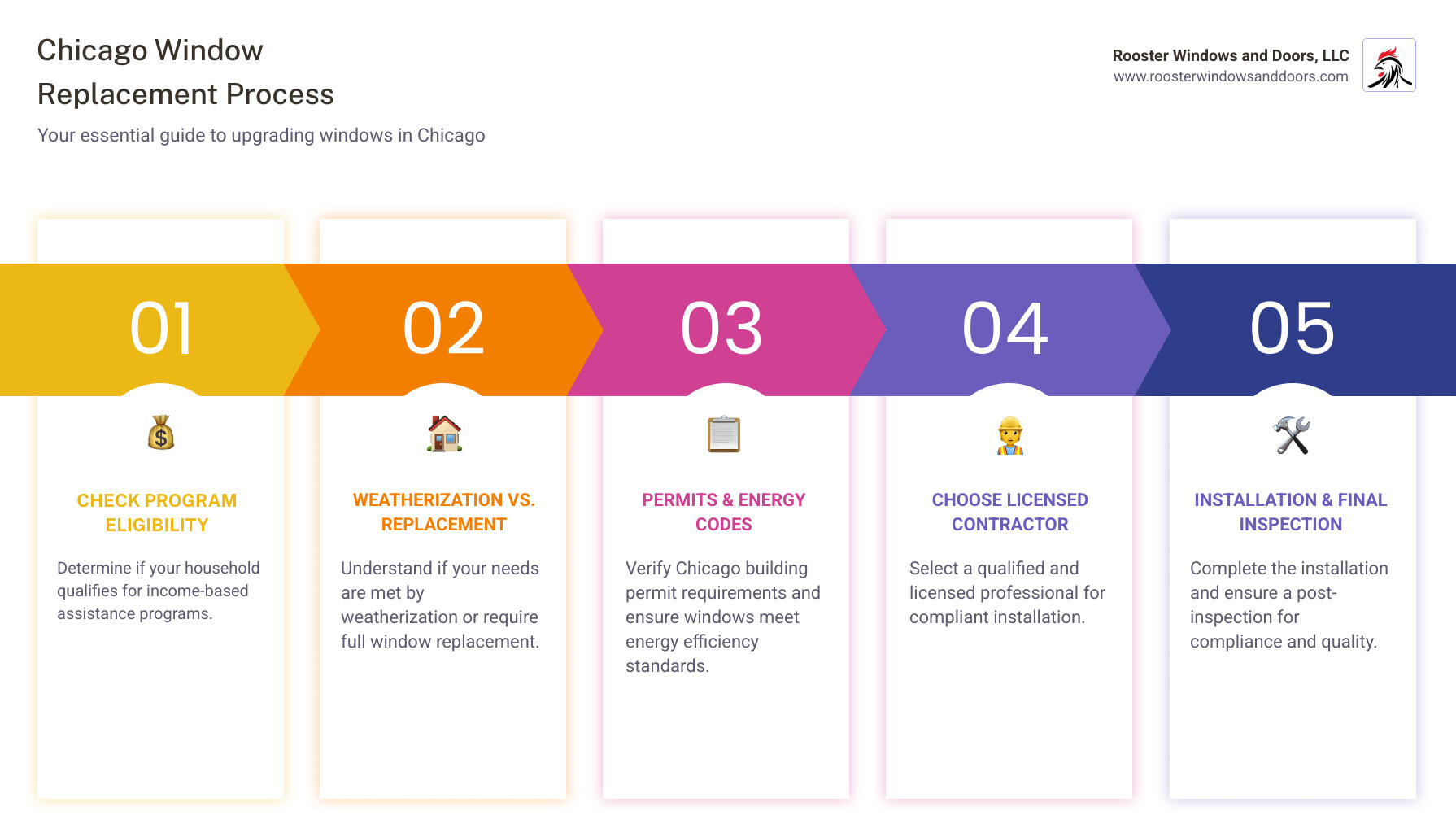
Window replacement program Chicago options range from government weatherization assistance for income-eligible homeowners to professional installation services and building permit requirements for all residents. Here’s what you need to know.
Quick overview of Chicago window-related programs and paths:
- Home Repair Program (HRP) – Provides roof, porch, and small accessibility repairs for households earning up to 50% of Area Median Income (closed for new applicants in 2026)
- Illinois Home Weatherization Assistance Program (IHWAP) – Offers up to $20,000 for energy-related weatherization, including window-adjacent improvements like air sealing and insulation
- CEDA Weatherization – Provides similar services for low-income households through community agencies
- Express Permit Program – Streamlined permit process for replacing windows and doors in existing openings
- Private installation services – Professional companies offering full window replacement with modern, energy-efficient options
Many homeowners find that most government programs focus on weatherization (air sealing, insulation, caulking) rather than paying for full window replacement. The Home Repair Program specifically notes that windows are not typically eligible for coverage. Still, understanding assistance programs alongside permit requirements and professional installation options helps you choose the right approach for comfort and energy performance.
Any replacement project also needs to align with Chicago requirements. The Chicago Energy Change Code sets minimum performance targets (such as U-value and solar heat gain), and the Express Permit Program offers a faster path for projects that stay within existing openings and meet the city’s conditions.
As Piotr Wilk from Rooster Windows and Doors, LLC, I’ve spent over two decades installing windows and doors throughout the Chicagoland area, helping homeowners steer window replacement program Chicago questions, permit requirements, and energy-efficient upgrades.
Find more about window replacement program chicago:
Understanding the Window Replacement Program Chicago Landscape
When considering a window replacement program Chicago, it’s helpful to understand what these programs typically do. Direct funding for full window replacement is less common; many initiatives focus on energy efficiency improvements that reduce drafts and energy loss and may complement a later window upgrade.
The City of Chicago and partners also promote residential efficiency through initiatives such as the Retrofit Chicago Residential Partnership, which has connected residents to assessments, recommendations, and installations of energy-saving products. While these efforts are broader than windows alone, they help homeowners prioritize improvements that can make high-performance windows more impactful.
For a deeper overview of replacement considerations, see our Chicago, IL Window Replacement Guide.
Eligibility for a Window Replacement Program Chicago
Eligibility for a window replacement program Chicago or related home improvement assistance usually depends on income and household characteristics. Many programs focus on low to moderate-income households, seniors, and people with disabilities.
For City of Chicago programs, eligibility is often tied to a percentage of the Area Median Income (AMI). For example, the Home Repair Program (HRP) targets households earning up to 50% of AMI, while the Emergency Heating Repair Program serves households earning 80% or less of AMI.
Illustrative income guidelines for programs like HRP (50% AMI, 2025 data from the research):
| Household Size | Annual Income (2025 – 50% AMI) |
|---|---|
| 1 | $42,000 |
| 2 | $48,000 |
| 3 | $54,000 |
| 4 | $59,950 |
| 5 | $64,750 |
| 6 | $69,550 |
| 7 | $74,350 |
| 8 | $79,150 |
For the Illinois Home Weatherization Assistance Program (IHWAP), eligibility may be set at 200% of the federal poverty level. For instance, a one-person household might need an annual income of $31,300 or less, while a four-person household would be $64,300 or less (based on 200% federal poverty level from research).
Residency requirements are also common: you must be a resident of Chicago or Cook County (depending on the program), and some programs require you to own and occupy the property.
If you’re weighing full replacement vs. targeted upgrades, it helps to understand window styles and performance features. See A Comprehensive Guide to the Best Window Replacement Options.
Specialized Assistance for Seniors and Low-Income Households
Chicago and Illinois programs may prioritize seniors and low-income households because they can be more vulnerable to high energy costs.
The Community and Economic Development Association of Cook County (CEDA) administers weatherization services for eligible homeowners in Cook County. Full window replacement is not typically covered, but measures such as air-sealing and insulation around existing windows can improve comfort and reduce drafts. Priority is often given to households with elderly members (60+), individuals with disabling conditions, or young children (5 and under).
Similarly, The Illinois Home Weatherization Assistance Program (IHWAP), administered by the Illinois Department of Commerce, supports energy-related weatherization and repairs. It can fund up to $20,000 per eligible client’s home for energy-related work and up to $4,000 for health and safety measures.
When you are ready for a full window upgrade, choosing qualified installers matters. See our guide on Window Installers Near Me.
Key Government and Non-Profit Assistance Programs
Several programs in Chicago and Illinois support home improvements that can indirectly improve window performance (for example, reducing drafts and heat loss).
The City of Chicago’s Home Repair Program (HRP), which continued elements of the former Roof and Porch Repair Program, focuses on roof or porch improvements and small accessibility repairs. Due to overwhelming demand, registration for the HRP will not be opening in 2026, and those who registered in 2024 and 2025 remain on a waitlist.
The Emergency Heating Repair Program provides grants to homeowners facing heating emergencies, serving households earning 80% or less of the Area Median Income. While it does not focus on windows, a tighter building envelope (including better-performing windows) can reduce heating load.
The Chicago Bungalow Association supports energy upgrades for eligible bungalow homeowners. These upgrades often emphasize weatherization measures that improve a home’s thermal envelope, which can make a later window replacement more effective.
CEDA runs a year-round weatherization program for qualifying residents in Cook County. Services can include caulking, air-sealing, insulating, and heating system repair and replacement. Direct full window replacement is not typically included, but sealing and insulation around existing windows can still make a noticeable comfort difference. Details are on the CEDA Weatherization Services page.
When you decide it’s time for new windows, we focus on solutions that complement weatherization work: correct sizing, proper flashing, and high-performance products installed to code. Learn more in our Energy Efficient Window Installation guide.
Weatherization vs. Full Window Replacement Program Chicago
It’s important to separate weatherization assistance from a full window replacement program Chicago. Programs like IHWAP and CEDA typically focus on weatherization: measures that reduce energy loss without replacing major components.
Weatherization commonly includes:
- Air sealing around leaks (including around windows and doors)
- Caulking gaps at trim and frames
- Adding or improving insulation
- HVAC or heating system repair/replacement where eligible
The Illinois Home Weatherization Assistance Program can fund up to $20,000 for energy-related work and up to $4,000 for health and safety measures. Window replacement may be limited unless a specific health or safety condition requires it.
A full window replacement removes older windows and installs new, code-compliant units designed for comfort, durability, and energy performance. For background on improving existing windows, the US Department of Energy’s Energy Saver site is helpful, and our How to Insulate Windows guide covers practical steps.
Documentation and Application Requirements
Applying for a window replacement program Chicago or related assistance generally requires documentation to confirm eligibility and property details. Typical items include:
- Proof of income for all household members (pay stubs, tax returns, Social Security statements, benefit letters)
- Proof of residency/ownership (deed, property tax bill, mortgage statement)
- Recent utility bills (electric and gas)
- Government-issued photo ID for adults
- Social Security number verification or qualified status documents
- Property information such as your Property Identification Number (PIN), available via the Cook County Assessor Property Search
These programs can be competitive and may involve wait times. If you’re budgeting for a private replacement, our Cost to Replace a Window Ultimate Guide can help set expectations.
Navigating Chicago Building Permits and Regulations
Even if you’re not participating in a window replacement program Chicago, a full window replacement still requires careful attention to permits and code compliance. Chicago has specific rules to ensure safety, structural integrity, and energy performance.
For many exterior window and door replacements, a permit is required. The city offers an Express Permit Program for replacement of doors, windows, and skylights in existing exterior wall and roof openings, generally for buildings up to 7 stories. Taller buildings or more complex conditions may require drawings prepared by an Illinois-licensed architect or structural engineer.
The Express Permit Program typically asks for:
- Property address and PIN
- Owner name and contact information
- Scope of work
- Existing condition photos
- An energy and water efficiency compliance form
Work must be performed by a licensed general contractor (Class A, B, C, D, or E, depending on project cost). A homeowner may act as their own general contractor for their owner-occupied property if they complete the city’s requirements.
Compliance with the Chicago Energy Change Code is required. Replacement windows and doors must meet minimum performance requirements, including U-value and solar heat gain limits.
For the city’s official process, see the Exterior Window or Door Replacement Permit Guide. For a broader view of what to expect from start to finish, read our Window Installation Services Complete Guide.
Fire-Rated and Safety Requirements
Some projects involve additional fire-rated and safety rules, including conditions that may fall outside a simple express permit. Examples include:
- Existing windows/doors containing fire-rated glass (especially those installed in 2019 or later)
- Windows/doors within 10 feet of a fire escape in buildings without a full automatic sprinkler system
- Openings close to a lot line (particularly in taller buildings)
The city also requires that replacement doors operate the same way as the door they replace and cannot reduce the clear opening dimension. New out-swinging windows must not create hazards on walkways or extend beyond property lines.
Safety glazing is required in locations defined by Chapter 24 of the Chicago Building Code (such as near doors and other impact-prone areas).
For residential replacement windows, opening control devices are required where the sill is less than 36 inches above the floor, limiting opening to less than 4 inches within 42 inches above the floor. Insect screens are required for openable replacement windows 50 feet or less above grade. Rodent protection (heavy wire screen or hardware cloth) is required for openable windows less than 24 inches above the ground.
More details are listed in the Exterior Window/Door Replacement Terms and Conditions. For below-grade openings and similar installations, see our Basement Windows Complete Guide.
Energy Efficiency Standards and U-Values
When planning a window replacement program Chicago project, energy performance is both a practical and code issue. The Chicago Energy Change Code sets minimum requirements for replacement windows and doors.
Two core metrics:
- U-value (U-factor): how well the window resists heat loss (lower is better).
- Solar Heat Gain Coefficient (SHGC): how much solar heat passes through the window (lower reduces unwanted summer heat gain).
Requirements can vary by product type and other conditions. The glazed area of a replacement window or skylight must also be equal to or greater than what it replaces.
If you’d like a general home efficiency checklist, the Energy Star Home Advisor tool can help, and our Energy Efficient Window Prices guide covers budgeting for higher-performance options.
Benefits of Professional Energy-Efficient Upgrades
While many public programs focus on weatherization, the benefits of investing in professionally installed, energy-efficient windows are broader than utility savings alone. At Rooster Windows and Doors, LLC, we install and replace windows and doors across Chicagoland, including Chicago, Libertyville, Evanston, Naperville, Arlington Heights, and beyond.
Key benefits homeowners typically see from modern, energy-efficient window upgrades include:
- Lower heating and cooling load: High-performance windows reduce heat transfer, helping your HVAC system maintain setpoint temperatures more efficiently.
- Improved comfort: Better insulation and tighter seals can reduce drafts and temperature swings near windows.
- Better indoor air control: Properly installed windows reduce uncontrolled air infiltration that can bring in dust and outdoor pollutants.
- Noise reduction: Multi-pane options like Double Pane Windows can noticeably reduce exterior noise.
- Curb appeal and resale value: New windows can modernize the look of your home and add buyer-friendly efficiency features.
- HVAC longevity: A tighter, more efficient home can reduce how hard your HVAC equipment must work.
- UV protection: Many modern glass packages reduce UV transmission to help protect flooring and furnishings.
- Fewer pest entry points: Correct installation and sealing helps limit gaps insects and rodents can use.
If you’re planning for costs and scope, our Window Replacement Cost Ultimate Guide can help you budget realistically.
Frequently Asked Questions about Chicago Window Programs
Chicago homeowners often search for a window replacement program Chicago expecting direct window funding. In practice, many programs focus on weatherization, repairs, or eligibility-limited grants. Here are common questions.
What are the income limitations for window assistance?
Income limits are typically based on AMI or the Federal Poverty Level and vary by household size.
Examples referenced in the research:
- City of Chicago Home Repair Program (HRP): 50% AMI (for 2025, a 1-person household was $42,000; an 8-person household was $79,150)
- Emergency Heating Repair Program: 80% or less of AMI
- Illinois Home Weatherization Assistance Program (IHWAP): often 200% of the federal poverty level (for example, $31,300 for 1 person or $64,300 for 4 people in 2024; verify current limits with the administrator)
Always confirm the latest published thresholds for the specific program you are applying to.
Are there specific deadlines for these programs?
Yes. Many assistance programs have registration windows, waitlists, or funding cycles.
- Home Repair Program (HRP): registration will not be opening in 2026 due to demand; 2024 and 2025 registrants remain on a waitlist and may be contacted in early 2026.
- Lottery/waitlist systems: some city programs have used limited registration periods when demand exceeds capacity.
- Annual cycles: state and federal programs may accept applications year-round, but service availability can depend on current funding and application volume.
- Utility incentives: programs from utilities can change, including deadlines and offer details.
How do I find a qualified contractor for my project?
For a private window replacement (or any work that requires permits), use a contractor who can meet Chicago requirements.
- Verify city licensing (general contractor licensing class may vary by project cost)
- Confirm insurance (liability and workers’ compensation)
- Look for Chicago-specific experience with permits, safety rules, and energy code compliance
- Request itemized quotes and clear scopes of work
- Review product and labor warranties
For more tips, see Best Window Installation Companies.
Conclusion
Navigating window replacement program Chicago options is easier when you separate weatherization assistance from full replacement. While direct financial help for new windows is uncommon, weatherization programs can improve comfort and reduce drafts, and they may complement a later window upgrade.
No matter how your project is funded, Chicago window replacements must follow permitting rules, fire and safety requirements, and the Chicago Energy Change Code.
At Rooster Windows and Doors, LLC, we specialize in high-quality, flawless, and energy-efficient window and door installations across Chicago and the surrounding suburbs. If you’re ready to compare window options, confirm code-compliant performance, and plan a professional installation, visit our Window Replacement page to learn more and request a quote.
